Last week I watched Walking With Dinosaurs, and not for the first time since I have memories of seeing it as a child on TV. It's a well-known British documentary made in the early 2000s that got a lot of attention for showing people a modern interpretation of dinosaurs and their kin that the older books and shows of the previous decades had mostly ignored (aside from the very popular Jurassic Park, which while not totally accurate was a good deal better than the old stuff). Together, Jurassic Park and Walking With Dinosaurs helped cement the image of dinosaurs as active, advanced, exciting animals into the public's mind. Before this, the prevailing view was that they were slow, sluggish, and unintelligent animals that died out from being unable to adapt to the world around them. The long-necked sauropods lived in the water and even the meat-eaters were pokey. However, all of those beliefs went out the window when people were finally exposed to the much more accurate findings made by scientists in more recent years. It took fancy computer graphics to get people to understand - even before Jurassic Park, a fantastic book released in the eighties titled The Dinosaur Heresies outlines the case for why the old theories were wrong and what the dinosaurs were really like. It's probably my favorite book on dinosaurs and I recommend it.
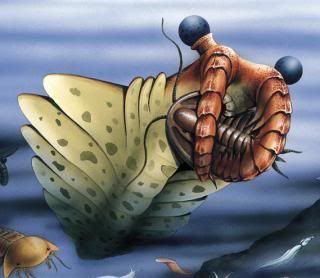
So you probably knew about Walking With Dinosaurs, but did you know it received two follow-up films? They were titled Walking With Monsters and Walking With Beasts. Walking With Monsters reviews the evolution of life before the dinosaurs, which began in earnest about 500 million years ago. The ruling predator of the time was the six-foot Anomalocaris, pictured below. It was a creature believed to be split off from the ancestors of modern arthropods (insects, spiders, centipedes, and crabs are examples of arthropods). No modern relatives of this half-billion-year-old creature exist.
Also featured in Walking With Monsters are three-foot-long scorpions, mighty 15-foot predatory fish, and the famous Dimetrodon, a reptile known for the large sail on its back, believed to be used to regulate body temperature.
Walking With Beasts goes into more familiar territory. It focuses on what happened to life on earth after the dinosaurs. For a time, it was as if dinosaurs had never left - one of the first major predators to appear was Gastornis, a giant bird the size of a human that probably behaved much like the famous raptor dinosaurs. In recent years, the theory has been advanced that dinosaurs and birds are so closely intertwined on the family tree that they cannot be properly separated, meaning that birds are a specialized group of dinosaurs that survived the mass extinction 65 million years ago. I may go into more detail about these ideas another time.
Later in the earth's history, the mammals finally took over, establishing themselves as the dominant creatures on earth. The later episodes of Walking With Beasts (it was a six-part miniseries) include spotlights on sabertooth cat and wooly mammoth societies, as well as Australopithecus - an ancestor of the human race. The Australopithecus episode depicts a small tribe of the chimplike animals and their daily trials. The sabertooth episode follows the story of Half-Tooth, a big, strong male who broke one of his sabers in a fight and now manages a pride of sabertooths. The final episode, taking place less than half a million years ago, is the story of Ice Age life, particularly the yearly migration of wooly mammoths as they move south in the fall to avoid the worst of winter.
All of the Walking With films are valuable looks into the past, and are engaging tools for learning more about the history of life on Earth. Just be prepared for some emotional scenes if you connect with animals - nature's constant struggle of predator against prey combined with the occasional natural disaster means multiple creatures die in every episode.
Showing posts with label Animals. Show all posts
Thursday, April 12, 2012
Friday, March 23, 2012
The Fairbanks Museum - The First Floor Continued
Here's one last post about the Fairbanks Museum. My mom shot some photographs of exhibits I didn't, or my photos came out poorly, so we return to the first floor one more time.
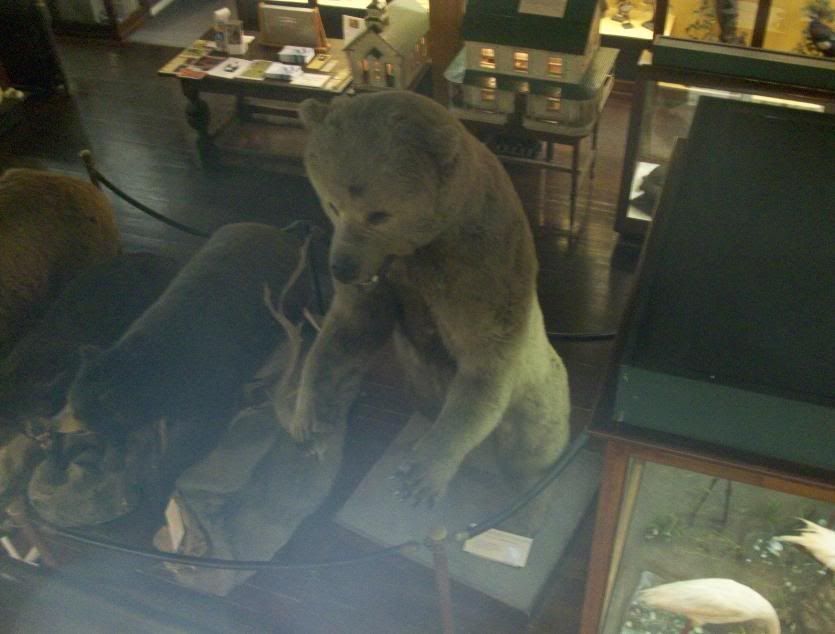
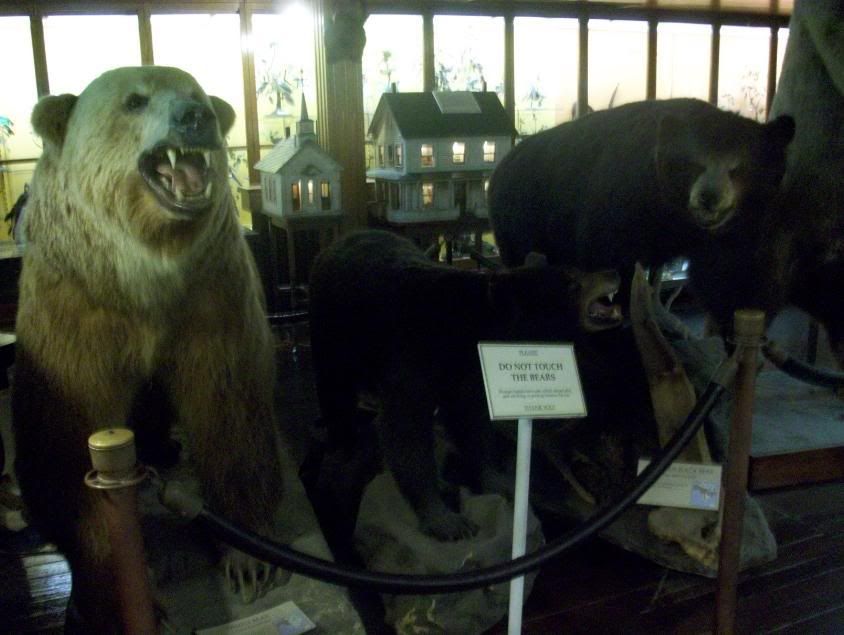
Ah, the bears. The first things you see when you walk into the museum are the bears. They stand front and center, without any glass to separate you from them to make it even more up-close and personal. There is an alarm set to go off if you touch them, though, plus a bunch of signs that urge you to not touch the bears.
Kodiak and polar bears are the largest land carnivores on the planet, and other species of bear are no slouches either. They're all here, and have undoubtedly been at the forefront of many a family photo. I suspect they're amongst the most-photographed attractions in the museum.
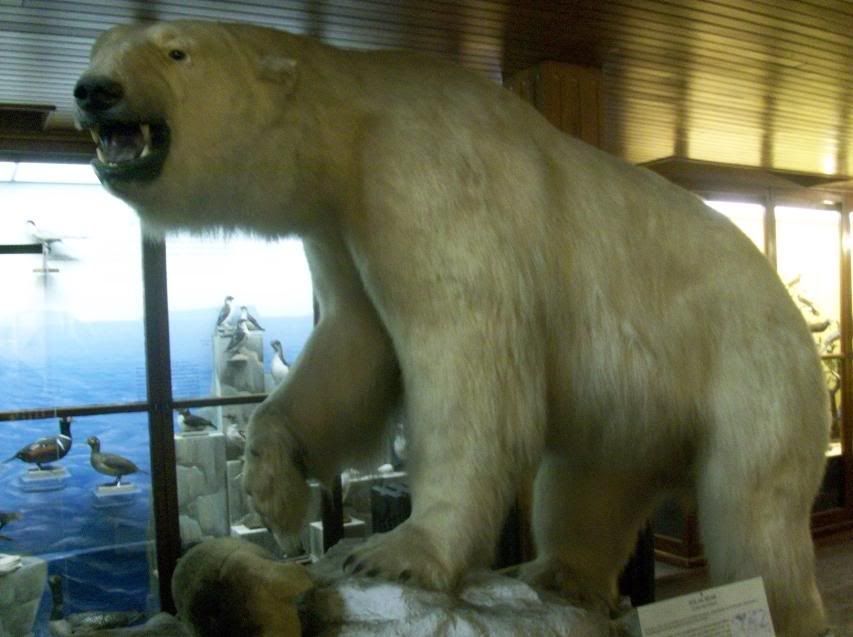
The polar bear is one of the most famous and iconic animals, and is probably the first animal you think of when you think "Arctic". If you also think of "Antarctic", take note - polar bears only live at the North Pole, not the South Pole. Meanwhile, penguins only live at the South Pole. Therefore, if you see penguins and polar bears together in a cartoon or something, the creator either didn't do their homework or didn't care about being accurate when making cartoons (a perfectly reasonable attitude if you're not trying to teach the kids).
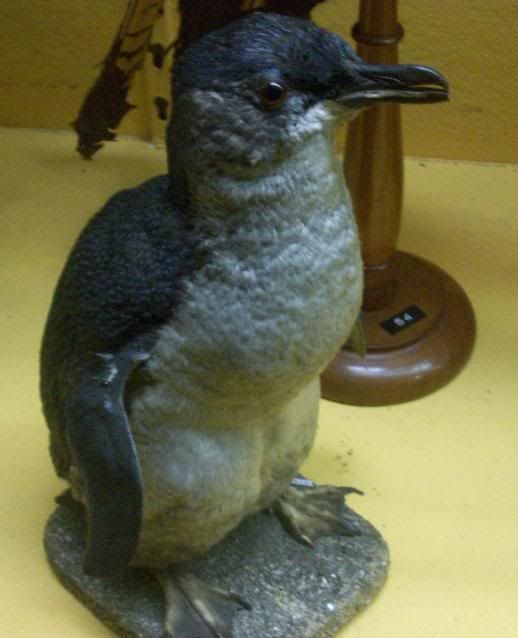
Speaking of penguins, look what else Mr. Fairbanks collected. This penguin wasn't labeled for whatever reason, and birds aren't my strongest area of animal knowledge so I don't know what species this is.
I idly wondered if perhaps the Fairbanks museum had any extinct animals on display. Perhaps it does - the sheer number of birds makes it downright likely one or two of the species has dwindled away in the last 120 years. However, the two I looked for were more famous examples - the dodo and the passenger pigeon - and I didn't find either. I later looked up dodos and discovered my error - the dodo went extinct in the 1600s, well over a hundred years before Mr. Fairbanks was even born, meaning he could never have gotten one for his collection.
The passenger pigeon, however, was still alive when the museum opened - it went extinct in the 1920s. I imagine if Fairbanks had such a bird, though, it would feature a good-sized plaque to tell the sad story of this species, and how humans somehow managed to make the most common bird in the world extinct.
Fairbanks does have one bird that almost went extinct - the California Condor, a bird that until recently was close to total extinction with only 22 left in the world. Since then, a breeding program has increased their numbers to just under 400.
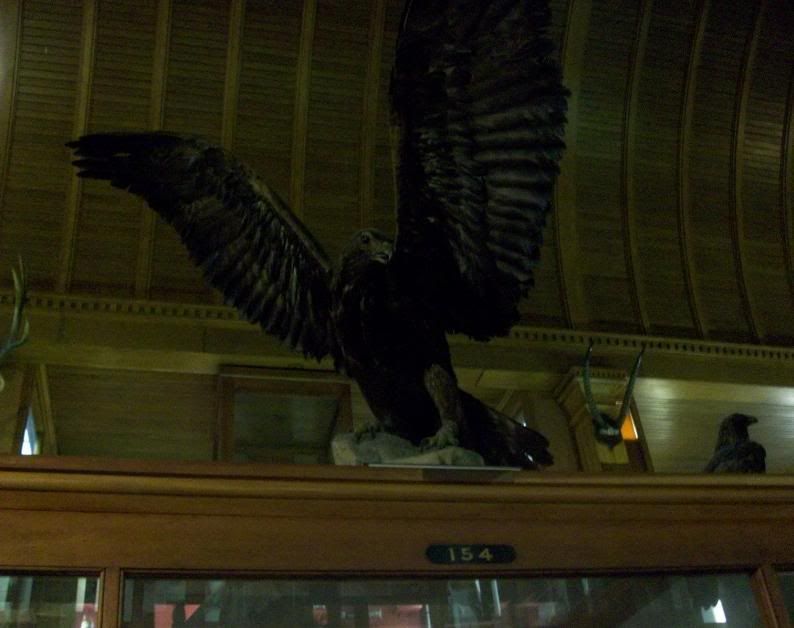
While we're on the subject of birds, my mom shot this picture of some sort of vulture or condor that I managed to miss entirely thanks to not looking up.
...Actually, this might be a California Condor. I think I somehow managed to see the plaque and miss the animal. That or Fairbanks has two of them, because I'm pretty sure I saw some sort of vulture behind glass. Oh well.
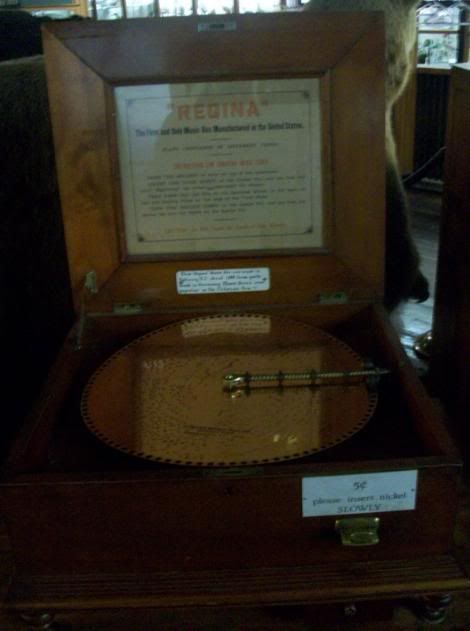
The first floor is dominated by animal specimens, but it's not exclusively their domain: there are a couple of other things to see here. This music box is one example - built in the late 19th century, it was sort of like a record player, but with just one record that played a wide variety of songs depending on where the needle is placed.
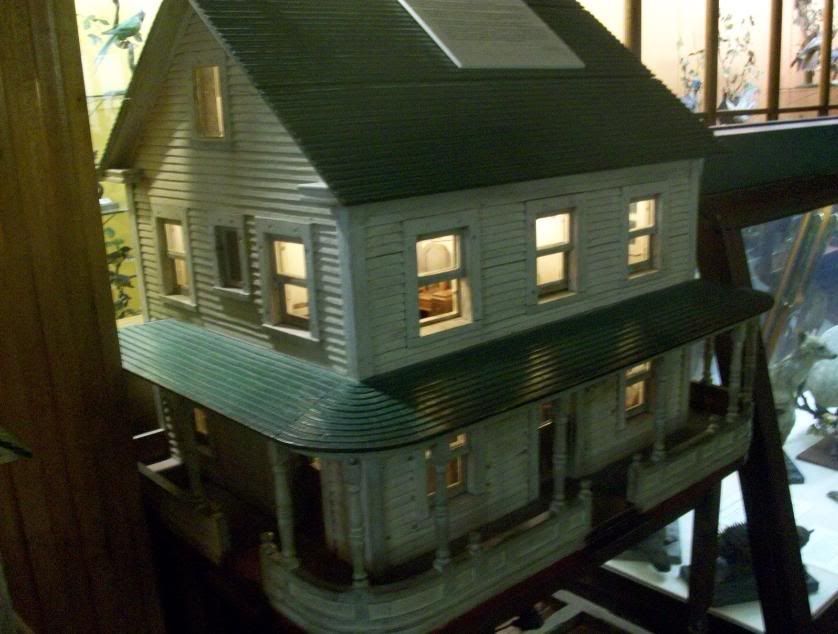
Mom loved this dollhouse. It was designed after the builder's dream house. He worked from the inside out and crafted intricate rooms with furniture, decorations, and little people to populate it.
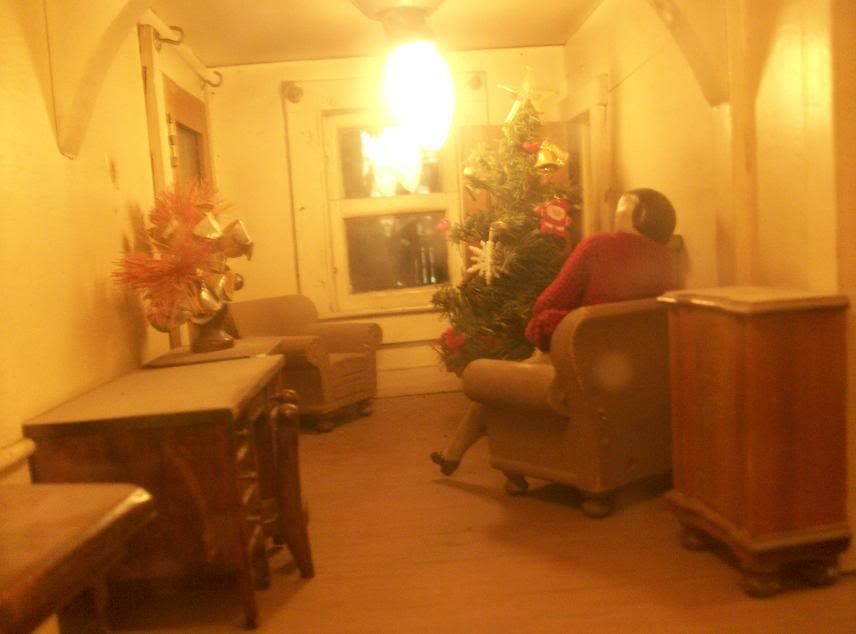
As if that wasn't cool enough, in this house it's always Christmas.
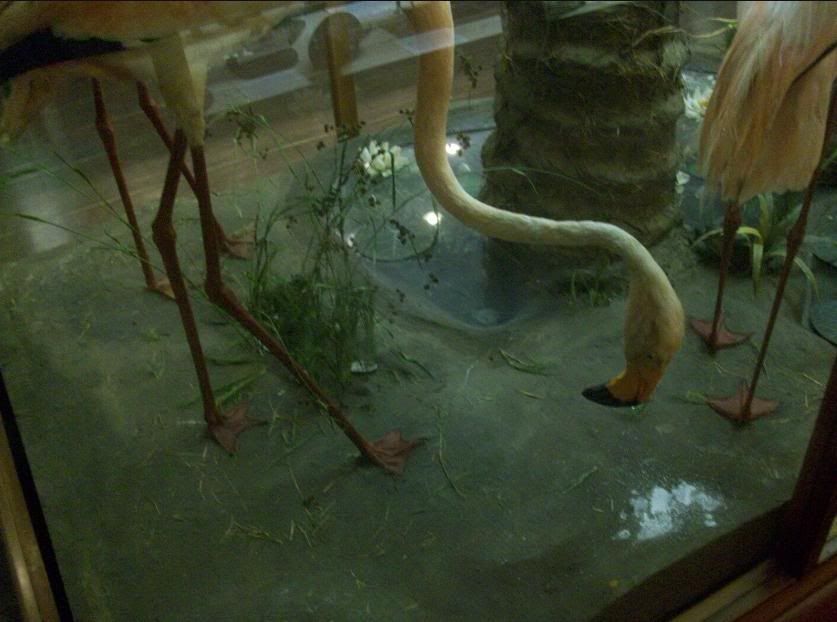
The Fairbanks Museum flamingos are white instead of pink. This is because flamingos get their color from the krill they eat. If fed something else, they will lose their pink color. It also fades after death, as these 120-year-old birds prove.
I've shared a lot of Fairbanks Museum in these four blog posts, but I still think it's worth your time to visit if you've never been. Not only is there plenty of stuff I didn't include, but actually visiting in person is a different experience from looking at pictures online. Plus, admission is reasonable.
By the way, Fairbanks Museum, like any attraction worth its salt, has a gift shop. There were a lot of comically overpriced things in there - one of the worst being little rubber bugs being sold for a dollar each when I can buy a bag of eight of those same bugs at the Dollar Tree for the same price - but I found something that wasn't too ridiculously marked up, was fitting to the museum, and was even practical. The thing I found was a 4-dollar pencil sharpener shaped like a potbelly stove, and although Fairbanks doesn't feature any stoves it's still evocative of the many antiques the second floor showcases. I took it home and immediately sharpened all my pencils. Definitely a good choice for souvenir.
Ah, the bears. The first things you see when you walk into the museum are the bears. They stand front and center, without any glass to separate you from them to make it even more up-close and personal. There is an alarm set to go off if you touch them, though, plus a bunch of signs that urge you to not touch the bears.
Kodiak and polar bears are the largest land carnivores on the planet, and other species of bear are no slouches either. They're all here, and have undoubtedly been at the forefront of many a family photo. I suspect they're amongst the most-photographed attractions in the museum.
The polar bear is one of the most famous and iconic animals, and is probably the first animal you think of when you think "Arctic". If you also think of "Antarctic", take note - polar bears only live at the North Pole, not the South Pole. Meanwhile, penguins only live at the South Pole. Therefore, if you see penguins and polar bears together in a cartoon or something, the creator either didn't do their homework or didn't care about being accurate when making cartoons (a perfectly reasonable attitude if you're not trying to teach the kids).
Speaking of penguins, look what else Mr. Fairbanks collected. This penguin wasn't labeled for whatever reason, and birds aren't my strongest area of animal knowledge so I don't know what species this is.
I idly wondered if perhaps the Fairbanks museum had any extinct animals on display. Perhaps it does - the sheer number of birds makes it downright likely one or two of the species has dwindled away in the last 120 years. However, the two I looked for were more famous examples - the dodo and the passenger pigeon - and I didn't find either. I later looked up dodos and discovered my error - the dodo went extinct in the 1600s, well over a hundred years before Mr. Fairbanks was even born, meaning he could never have gotten one for his collection.
The passenger pigeon, however, was still alive when the museum opened - it went extinct in the 1920s. I imagine if Fairbanks had such a bird, though, it would feature a good-sized plaque to tell the sad story of this species, and how humans somehow managed to make the most common bird in the world extinct.
Fairbanks does have one bird that almost went extinct - the California Condor, a bird that until recently was close to total extinction with only 22 left in the world. Since then, a breeding program has increased their numbers to just under 400.
While we're on the subject of birds, my mom shot this picture of some sort of vulture or condor that I managed to miss entirely thanks to not looking up.
...Actually, this might be a California Condor. I think I somehow managed to see the plaque and miss the animal. That or Fairbanks has two of them, because I'm pretty sure I saw some sort of vulture behind glass. Oh well.
The first floor is dominated by animal specimens, but it's not exclusively their domain: there are a couple of other things to see here. This music box is one example - built in the late 19th century, it was sort of like a record player, but with just one record that played a wide variety of songs depending on where the needle is placed.
Mom loved this dollhouse. It was designed after the builder's dream house. He worked from the inside out and crafted intricate rooms with furniture, decorations, and little people to populate it.
As if that wasn't cool enough, in this house it's always Christmas.
The Fairbanks Museum flamingos are white instead of pink. This is because flamingos get their color from the krill they eat. If fed something else, they will lose their pink color. It also fades after death, as these 120-year-old birds prove.
I've shared a lot of Fairbanks Museum in these four blog posts, but I still think it's worth your time to visit if you've never been. Not only is there plenty of stuff I didn't include, but actually visiting in person is a different experience from looking at pictures online. Plus, admission is reasonable.
By the way, Fairbanks Museum, like any attraction worth its salt, has a gift shop. There were a lot of comically overpriced things in there - one of the worst being little rubber bugs being sold for a dollar each when I can buy a bag of eight of those same bugs at the Dollar Tree for the same price - but I found something that wasn't too ridiculously marked up, was fitting to the museum, and was even practical. The thing I found was a 4-dollar pencil sharpener shaped like a potbelly stove, and although Fairbanks doesn't feature any stoves it's still evocative of the many antiques the second floor showcases. I took it home and immediately sharpened all my pencils. Definitely a good choice for souvenir.
Tuesday, March 20, 2012
The Fairbanks Museum - The Second Floor Continued
The front right corner of the Fairbanks Museum upper balcony features a small but nonetheless very cool selection of fossils.
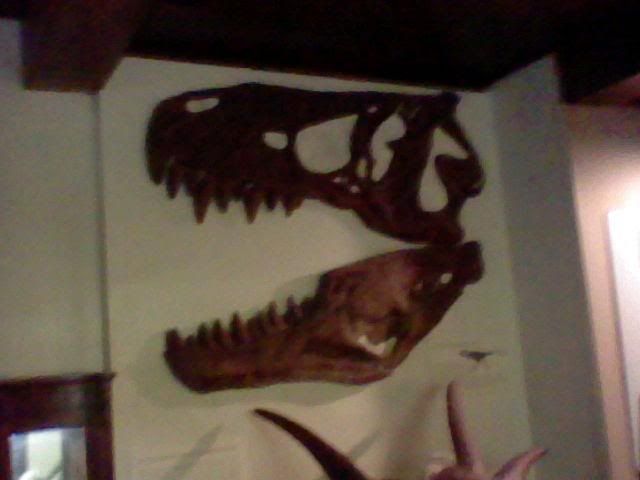
The T Rex skull does a pretty good job of grabbing your attention, as does the Styracosaurus skull beneath it. Everybody knows T Rex. Styracosaurus is a bit more obscure, but to put it simply, this dinosaur was a close relative of the very famous Triceratops, just with more horns.
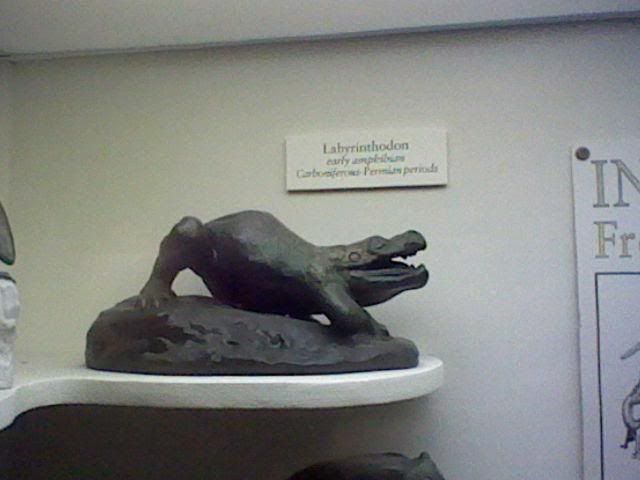
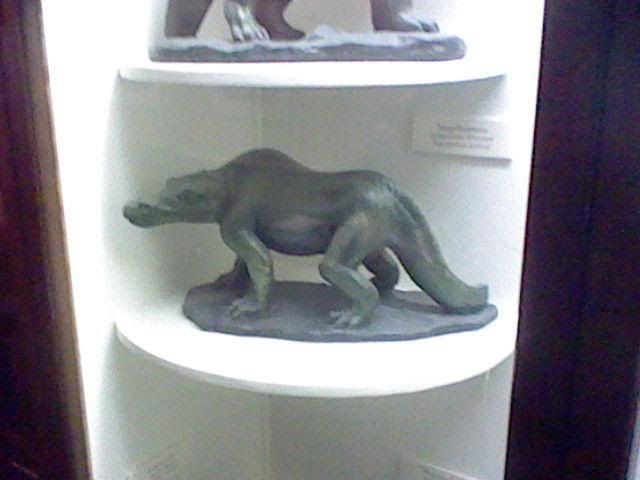
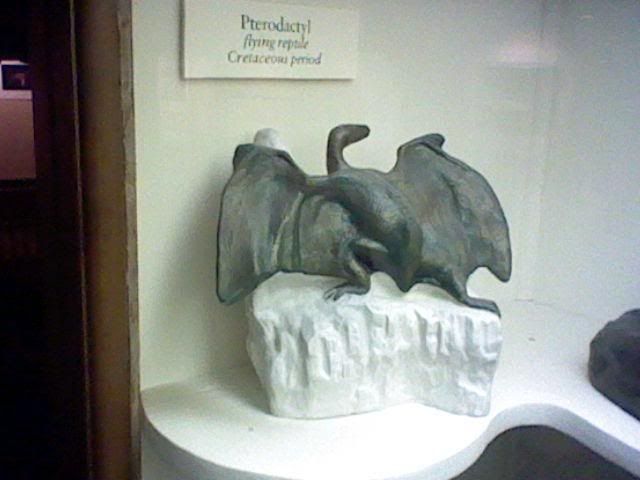
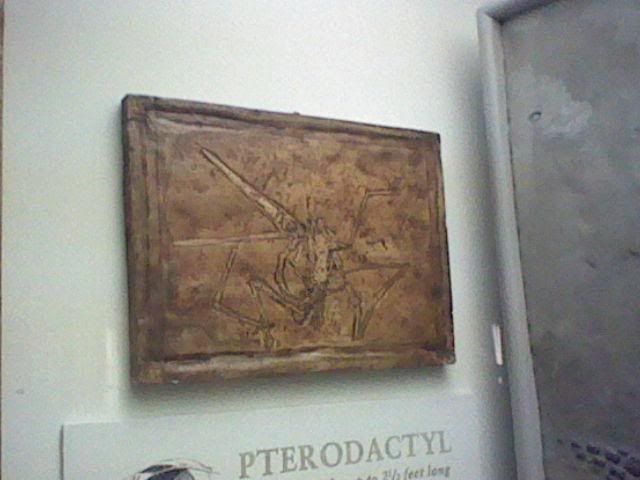
This was REALLY cool. Fairbanks had some statues of dinosaurs based on how people in the Victorian era thought they looked and acted. This 19th-century depiction of dinosaurs has been proven false by more recent discoveries, particularly from the seventies and onward, but the creatures imagined by the earliest dinosaur researchers are nonetheless fascinating. That pterodactyl fossil was pretty awesome, too. Also on display are a Dimetrodon foot, a fossil of a tiny dinosaur called Compsognathus, and several plaques discussing how people perceived dinosaurs over the years and, of course, the extinction of the group.
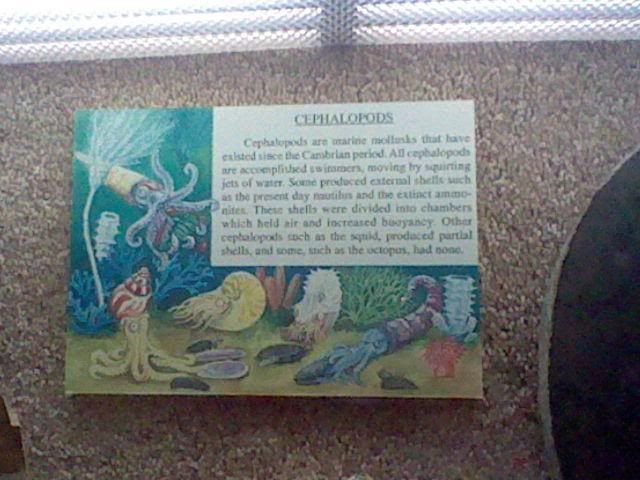
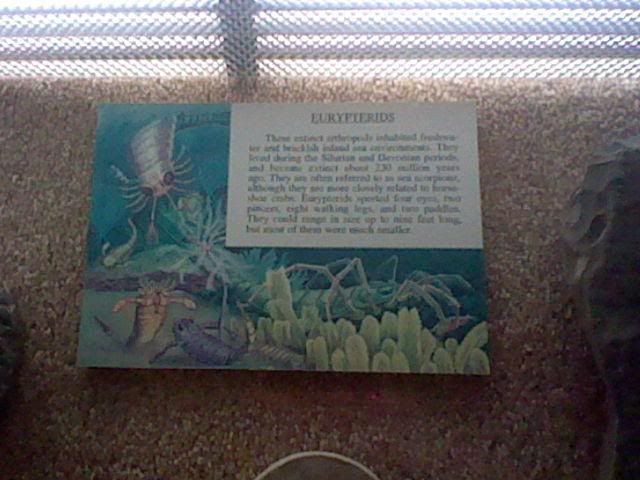
Here's a couple of plaques talking about animals that lived long before dinosaurs. The cephalopod family has a long history, and it still endures today in the form of the octopus, squid, nautilus, and cuttlefish. Sea scorpions, however, have been extinct for a very long time. Honestly, I'm kind of saddened by that, as I think sea scorpions are some of the most amazing-looking of all prehistoric animals. I wonder if one day an artificial robot sea scorpion will swim in a tank in a museum of the future to show people how they looked and behaved...
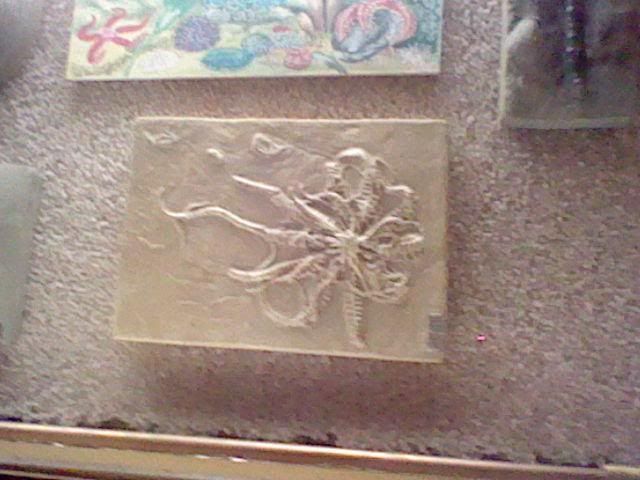
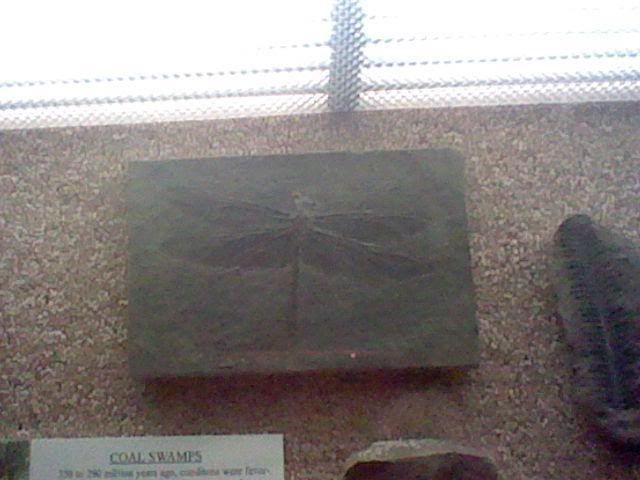
Two more fossils, one of which is a dragonfly a bit larger than most modern species. The other appears to be a starfish ancestor. I'm not certain which of the fossils at Fairbanks are genuine - the dinosaur skulls are stated on their plaques to be casts. One fossil on display that I didn't photograph was a trilobite shell. Trilobites, which looked a bit like horseshoe crabs, were not only very common in pre-dinosaur oceans, but they also shed their shells a lot, so there are lots of trilobite fossils. For that reason I'm pretty sure the trilobite fossil, at least, was the real thing and not a cast.
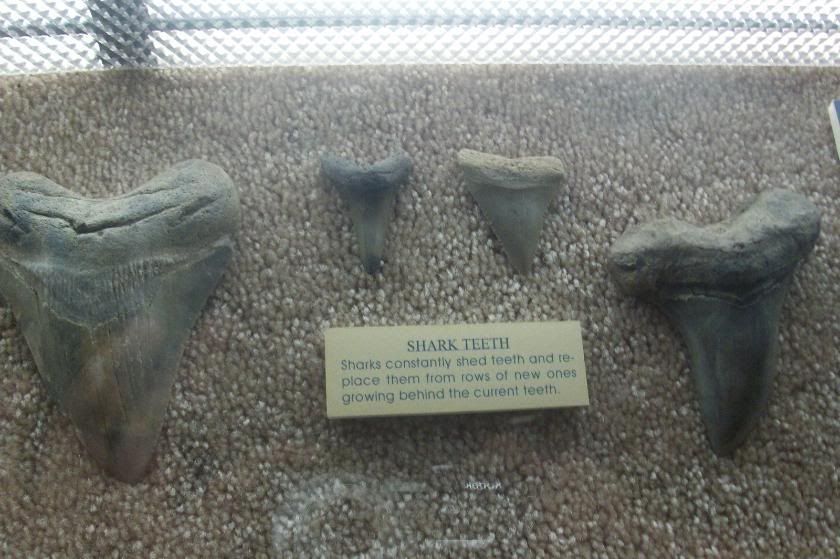
For the same reason, these shark teeth are definitely genuine. Sharks shed their teeth constantly, as the little plaque points out, so fossils are plentiful.
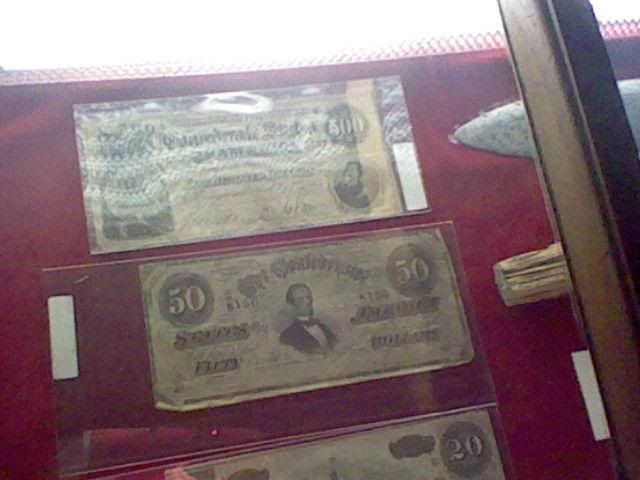
My mom liked the fossils, but she was definitely more intrigued by the Civil War section, which was next. Here we see some Confederate money, from the brief period of time when the confederacy was its own country.
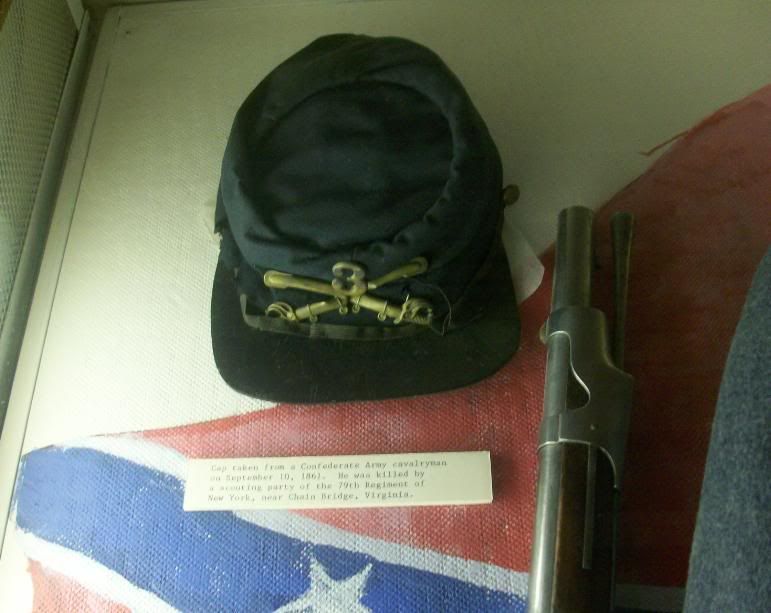
The Civil War section was very well put together, showing a Confederate's weapons and equipment on one side and a United States soldier's stuff on the other side. Also on display were a couple of newspapers from around the same time period. Their advertisements were included for extra humor - five cents an issue! Dollar-fifty for a full year! Highway robbery, I do declare!
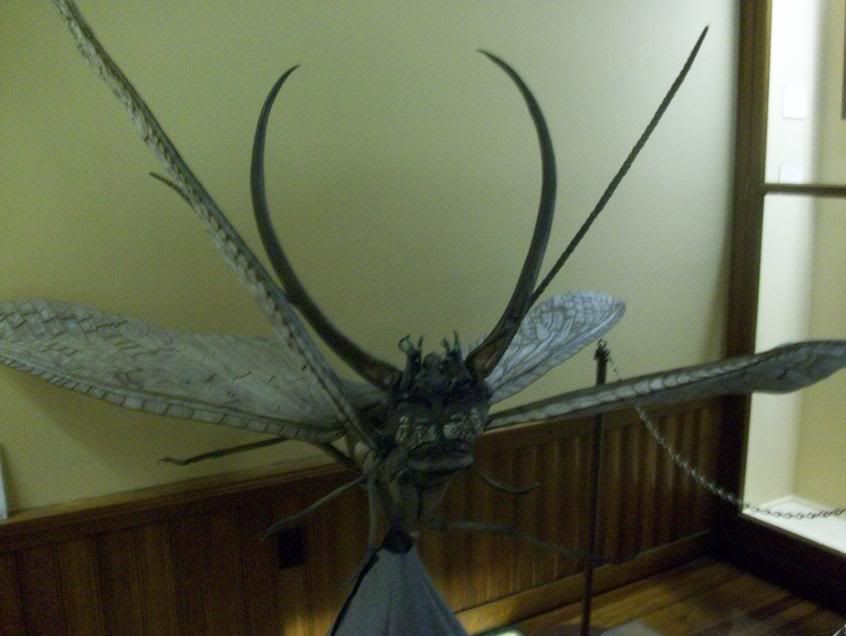
Among the last things we got a good look at on the second floor was this scaled-up model of a dobsonfly. As you might expect, I was intrigued and my mom was creeped out.
The dobsonfly is a very strange insect that can be found in Vermont, although I've never seen one. They are among the largest insects in New England, reaching up to five inches in length with ten-inch wingspans, and the males have giant pinching jaws, like the model. However, they have no poison and their jaws are actually so gigantic as to be hilariously unwieldy. They can't harm humans. The females, however, have much shorter jaws which they can use to great effect to draw blood from a human who mishandles them. If you see a female dobsonfly, show respect!
Dobsonflies only live a few weeks. They spend most of their lives (a few years) as hellgrammites, which look like what you'd get if you crossed a caterpillar with a stag beetle. These ferocious babies possess the same jaws the female adult does regardless of gender, so watch out! They live in freshwater, and if they are present it's a sign that the water is very clean and free of pollution, since hellgammites cannot survive in dirty water.
In my next and for now final post on the Fairbanks Museum, we'll take one last look downstairs at the preserved animals. There will be bears.
And dollhouses.
The T Rex skull does a pretty good job of grabbing your attention, as does the Styracosaurus skull beneath it. Everybody knows T Rex. Styracosaurus is a bit more obscure, but to put it simply, this dinosaur was a close relative of the very famous Triceratops, just with more horns.
This was REALLY cool. Fairbanks had some statues of dinosaurs based on how people in the Victorian era thought they looked and acted. This 19th-century depiction of dinosaurs has been proven false by more recent discoveries, particularly from the seventies and onward, but the creatures imagined by the earliest dinosaur researchers are nonetheless fascinating. That pterodactyl fossil was pretty awesome, too. Also on display are a Dimetrodon foot, a fossil of a tiny dinosaur called Compsognathus, and several plaques discussing how people perceived dinosaurs over the years and, of course, the extinction of the group.
Here's a couple of plaques talking about animals that lived long before dinosaurs. The cephalopod family has a long history, and it still endures today in the form of the octopus, squid, nautilus, and cuttlefish. Sea scorpions, however, have been extinct for a very long time. Honestly, I'm kind of saddened by that, as I think sea scorpions are some of the most amazing-looking of all prehistoric animals. I wonder if one day an artificial robot sea scorpion will swim in a tank in a museum of the future to show people how they looked and behaved...
Two more fossils, one of which is a dragonfly a bit larger than most modern species. The other appears to be a starfish ancestor. I'm not certain which of the fossils at Fairbanks are genuine - the dinosaur skulls are stated on their plaques to be casts. One fossil on display that I didn't photograph was a trilobite shell. Trilobites, which looked a bit like horseshoe crabs, were not only very common in pre-dinosaur oceans, but they also shed their shells a lot, so there are lots of trilobite fossils. For that reason I'm pretty sure the trilobite fossil, at least, was the real thing and not a cast.
For the same reason, these shark teeth are definitely genuine. Sharks shed their teeth constantly, as the little plaque points out, so fossils are plentiful.
My mom liked the fossils, but she was definitely more intrigued by the Civil War section, which was next. Here we see some Confederate money, from the brief period of time when the confederacy was its own country.
The Civil War section was very well put together, showing a Confederate's weapons and equipment on one side and a United States soldier's stuff on the other side. Also on display were a couple of newspapers from around the same time period. Their advertisements were included for extra humor - five cents an issue! Dollar-fifty for a full year! Highway robbery, I do declare!
Among the last things we got a good look at on the second floor was this scaled-up model of a dobsonfly. As you might expect, I was intrigued and my mom was creeped out.
The dobsonfly is a very strange insect that can be found in Vermont, although I've never seen one. They are among the largest insects in New England, reaching up to five inches in length with ten-inch wingspans, and the males have giant pinching jaws, like the model. However, they have no poison and their jaws are actually so gigantic as to be hilariously unwieldy. They can't harm humans. The females, however, have much shorter jaws which they can use to great effect to draw blood from a human who mishandles them. If you see a female dobsonfly, show respect!
Dobsonflies only live a few weeks. They spend most of their lives (a few years) as hellgrammites, which look like what you'd get if you crossed a caterpillar with a stag beetle. These ferocious babies possess the same jaws the female adult does regardless of gender, so watch out! They live in freshwater, and if they are present it's a sign that the water is very clean and free of pollution, since hellgammites cannot survive in dirty water.
In my next and for now final post on the Fairbanks Museum, we'll take one last look downstairs at the preserved animals. There will be bears.
And dollhouses.
Saturday, March 17, 2012
The Fairbanks Museum - The First Floor
The Fairbanks Museum is located in St. Johnsbury, Vermont, a ways from my home but a doable distance. I've visited Fairbanks at least three times in my life, and it hasn't changed much.
The museum is housed in a great old Victorian building, and was opened to the public in 1891. Joseph Fairbanks was the man responsible, who believed in educating the public about natural history. His extensive collection of curios has been preserved here for future generations. My mother and I visited Fairbanks on the 15th, and I brought my Nintendo 3DS along because it has a rudimentary camera function. Here's the first of two photo tours of the museum - and there's a lot I didn't photograph.
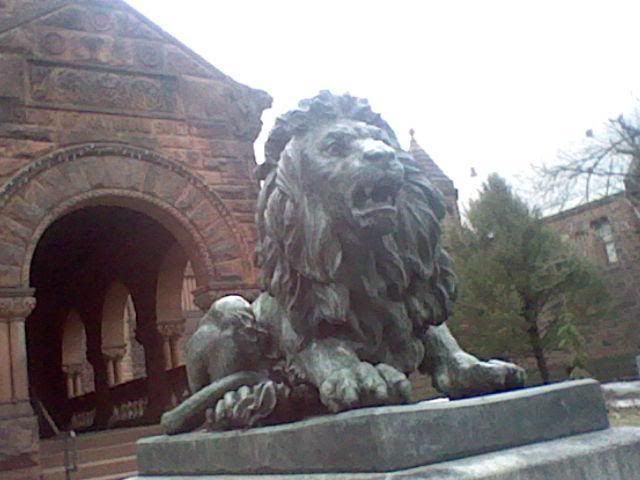
You'll start seeing interesting things before even entering the museum. There are two lion statues out front that lend a special air to the place. The building itself is just as fancy, with ornate carvings of humans and gargoyles. I tried to photograph the gargoyles but the shot came out poorly.
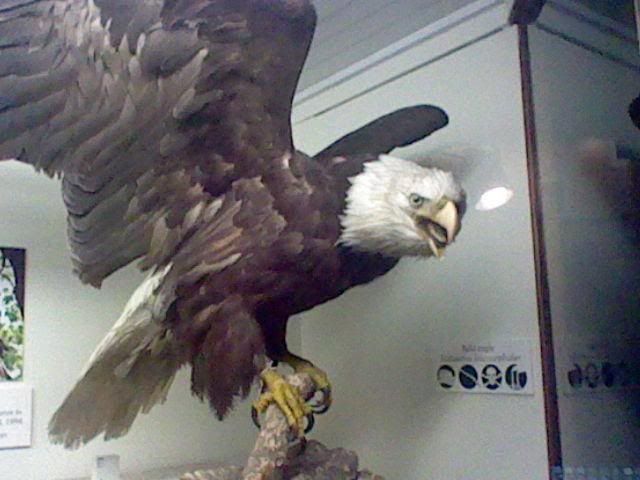
The majority of things to see on the first floor are preserved animals. Mr. Fairbanks worked together with one particular taxidermist to create the majority of his collection, and most of these specimens are therefore the same age or older than the museum, meaning they are at least 121 years old. Nobody who was alive when this eagle was alive is still with us today, and yet the eagle still looks as big as life, ready to fly out of its glass enclosure and into the sky. Just think about that.
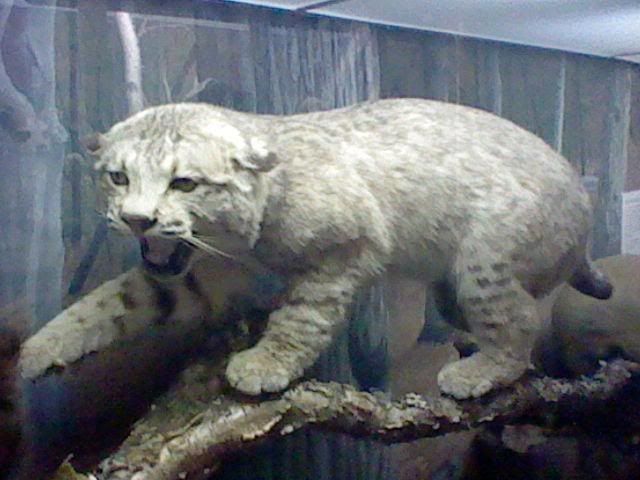
Of course, taxidermy isn't perfect. Some of the animals in the museum looked a little odd, like the taxidermist had messed up a bit when creating them. This was most common with the mammals. I focused on photographing the better-looking specimens, but if you ever go there and take a good look at the bobcats, you'll see what i mean.
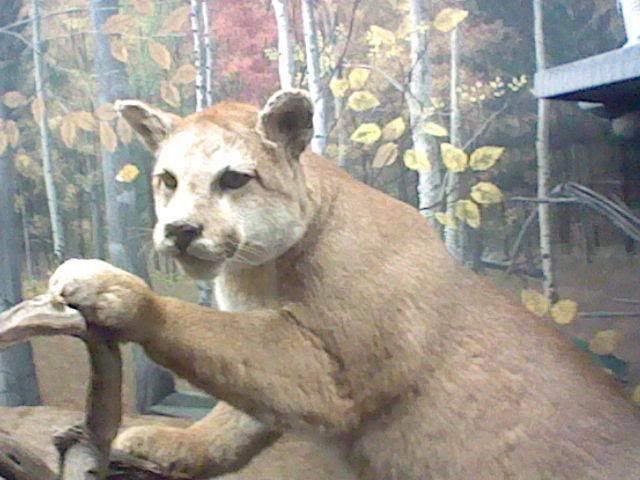
This animal goes by many names. You've heard of cougars? How about pumas? Mountain lions? Did you know all of those animals are actually the same thing? The mountain lion/cougar/puma is the biggest cat in the "small cats" division of the cat family.
The distinction between "big cats" and "small cats" isn't about size - that's a lucky coincidence. It's just how the cat family tree splits up. One group of cats - the lion, tiger, jaguar, and leopard - evolved large size and the ability to roar. All other cat species - wildcats, lynx, cougars, and the domestic cat, to name a few - cannot roar. There's a third group, too - the cheetah split off from other cats early on, and that's why it may look "un-catlike" in some ways. Cheetahs cannot roar.
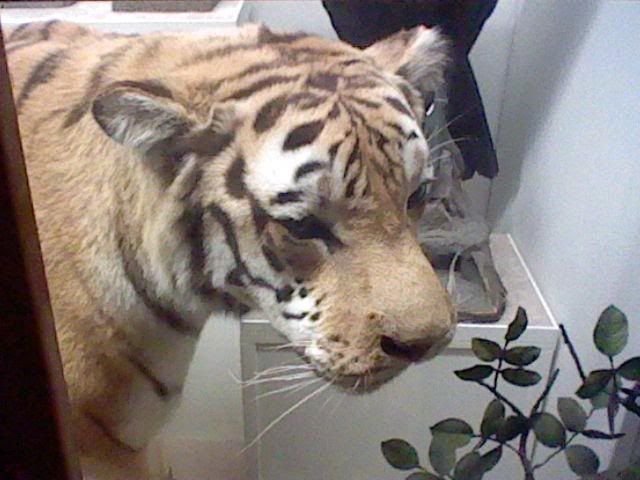
The Fairbanks Museum contains mostly "small cats". This tiger is the only exception, and he is quite well preserved. Many of the standard "jungle animals" are not present at Fairbanks - there are no preserved lions, gorillas, hippos, rhinos, giraffes, etc. Most of the more exotic animals from other countries are quite small, making this tiger stand out.
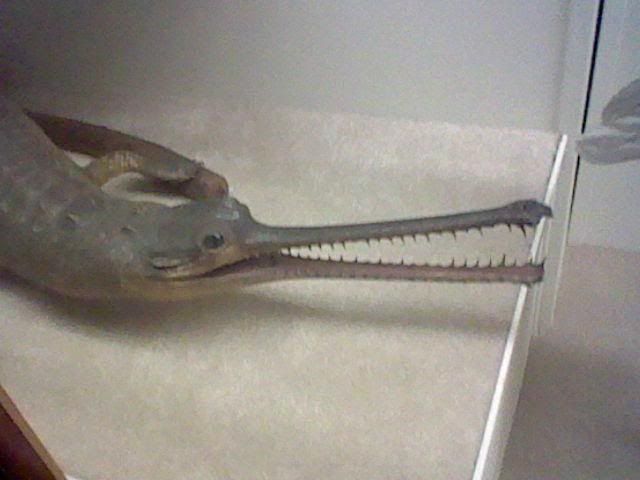
Fairbanks is home to two stuffed crocodilians. The first is an alligator, large and impressive. The second is this decidedly more obscure creature, the gavial or gharial. It looks like a miniature crocodile, except for the extremely long and thin jaws. These jaws are specially designed to catch fish, and the needle-like teeth help keep a grip on them so they don't slip away.
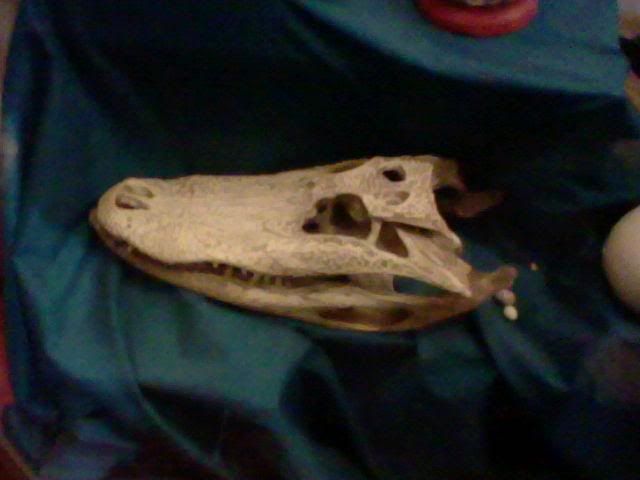
Also contributing to the crocodile family's presence at Fairbanks is this alligator skull. When you first enter the museum, start by going to your left and checking out the glass tank that contains this skull alongside a peacock and a number of other animals - this is the best place to begin a museum tour thanks to the informative signs that introduce Mr. Fairbanks and quote him directly concerning his mission and the founding of the museum. There's even a letter he wrote himself on display.
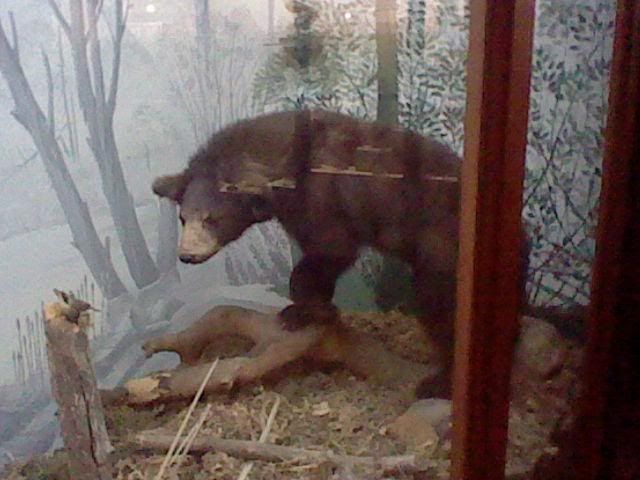
Most people who've gone to Fairbanks Museum will instantly associate one thing with it: Bears. Even though birds are by far the most common animals at the museum, its the collection of six or so bears that catch people's attention. I was unable to get a good photo of the biggest and most impressive bears, but they've got all of the classics: a black bear, a grizzly bear, and a mighty polar bear. They're very imposing and undoubtedly among the most popular of the exhibits.
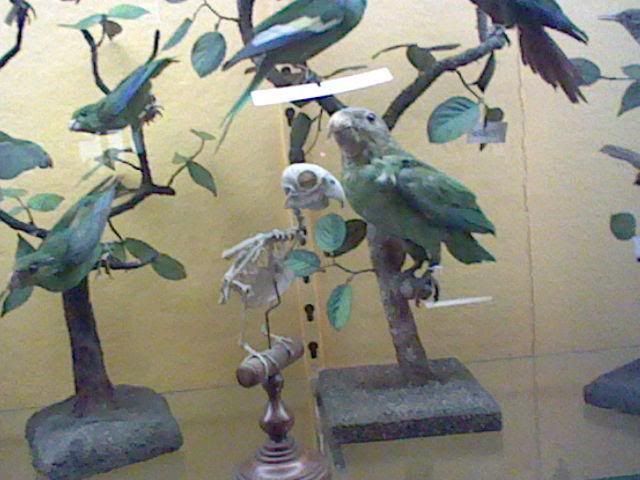
There are literally thousands of birds at Fairbanks. There are several hundred hummingbirds alone. Bird taxidermy was in fashion in Fairbanks' time, so he wound up with quite a collection of dead feathered friends. I am not a particularly huge bird fan so I didn't take too many bird pictures, but this parrot skeleton was too unique to pass up.
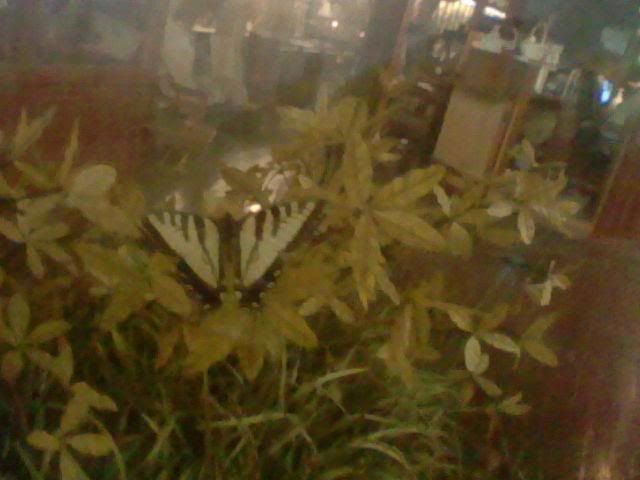
There are not very many insects at Fairbanks, to my disappointment. Most of them are "accessories" to larger displays. There is one really interesting insect exhibit - a giant model of a dobsonfly - on the second floor. For whatever reason I didn't photograph it. Aside from the dobsonfly, you'll only see a few insects here and there, like this butterfly which was nestled in a larger enclosure dedicated to mammals.
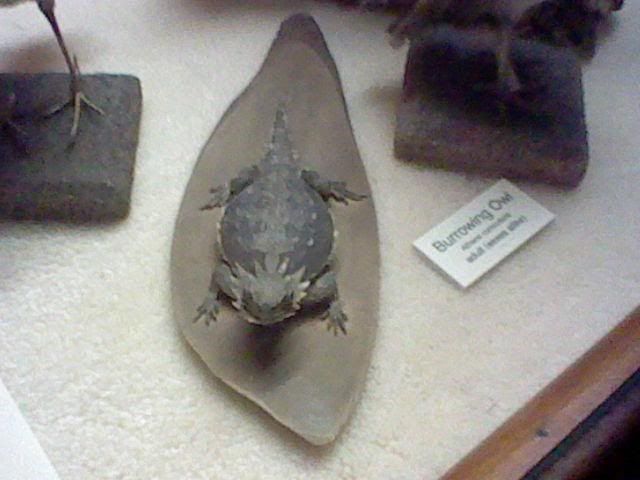
I think reptiles are good choices for taxidermy as they seem easy to "get right" without looking unnatural. This horned lizard is a good example - he looks pretty great for being 120 years old. It's not always a sure thing, though - a couple of the snakes in the snake tank looked odd. I took a snake photo but it came out very poorly so you won't be seeing it here.
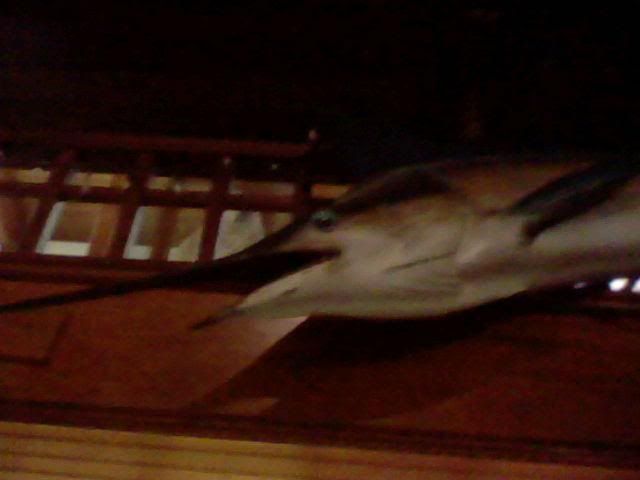
On the outside of the railing between the first and second floor were a number of large fish. There was a shark, a sailfish, a tarpon, and this marlin. The marlin is known for being one of the fastest animals in the ocean, capable of reaching speeds of over 50 miles an hour. When it finds a school of fish, it attacks by waving its swordlike snout around, stunning or killing its prey.
That does it for the first floor. There were many animals I didn't photograph - everything from monkeys to a pelican, a pike, an albatross, a wolf, and a bison. Next post, we venture upstairs to see what else Fairbanks Museum can offer besides dead animals!
The museum is housed in a great old Victorian building, and was opened to the public in 1891. Joseph Fairbanks was the man responsible, who believed in educating the public about natural history. His extensive collection of curios has been preserved here for future generations. My mother and I visited Fairbanks on the 15th, and I brought my Nintendo 3DS along because it has a rudimentary camera function. Here's the first of two photo tours of the museum - and there's a lot I didn't photograph.
You'll start seeing interesting things before even entering the museum. There are two lion statues out front that lend a special air to the place. The building itself is just as fancy, with ornate carvings of humans and gargoyles. I tried to photograph the gargoyles but the shot came out poorly.
The majority of things to see on the first floor are preserved animals. Mr. Fairbanks worked together with one particular taxidermist to create the majority of his collection, and most of these specimens are therefore the same age or older than the museum, meaning they are at least 121 years old. Nobody who was alive when this eagle was alive is still with us today, and yet the eagle still looks as big as life, ready to fly out of its glass enclosure and into the sky. Just think about that.
Of course, taxidermy isn't perfect. Some of the animals in the museum looked a little odd, like the taxidermist had messed up a bit when creating them. This was most common with the mammals. I focused on photographing the better-looking specimens, but if you ever go there and take a good look at the bobcats, you'll see what i mean.
This animal goes by many names. You've heard of cougars? How about pumas? Mountain lions? Did you know all of those animals are actually the same thing? The mountain lion/cougar/puma is the biggest cat in the "small cats" division of the cat family.
The distinction between "big cats" and "small cats" isn't about size - that's a lucky coincidence. It's just how the cat family tree splits up. One group of cats - the lion, tiger, jaguar, and leopard - evolved large size and the ability to roar. All other cat species - wildcats, lynx, cougars, and the domestic cat, to name a few - cannot roar. There's a third group, too - the cheetah split off from other cats early on, and that's why it may look "un-catlike" in some ways. Cheetahs cannot roar.
The Fairbanks Museum contains mostly "small cats". This tiger is the only exception, and he is quite well preserved. Many of the standard "jungle animals" are not present at Fairbanks - there are no preserved lions, gorillas, hippos, rhinos, giraffes, etc. Most of the more exotic animals from other countries are quite small, making this tiger stand out.
Fairbanks is home to two stuffed crocodilians. The first is an alligator, large and impressive. The second is this decidedly more obscure creature, the gavial or gharial. It looks like a miniature crocodile, except for the extremely long and thin jaws. These jaws are specially designed to catch fish, and the needle-like teeth help keep a grip on them so they don't slip away.
Also contributing to the crocodile family's presence at Fairbanks is this alligator skull. When you first enter the museum, start by going to your left and checking out the glass tank that contains this skull alongside a peacock and a number of other animals - this is the best place to begin a museum tour thanks to the informative signs that introduce Mr. Fairbanks and quote him directly concerning his mission and the founding of the museum. There's even a letter he wrote himself on display.
Most people who've gone to Fairbanks Museum will instantly associate one thing with it: Bears. Even though birds are by far the most common animals at the museum, its the collection of six or so bears that catch people's attention. I was unable to get a good photo of the biggest and most impressive bears, but they've got all of the classics: a black bear, a grizzly bear, and a mighty polar bear. They're very imposing and undoubtedly among the most popular of the exhibits.
There are literally thousands of birds at Fairbanks. There are several hundred hummingbirds alone. Bird taxidermy was in fashion in Fairbanks' time, so he wound up with quite a collection of dead feathered friends. I am not a particularly huge bird fan so I didn't take too many bird pictures, but this parrot skeleton was too unique to pass up.
There are not very many insects at Fairbanks, to my disappointment. Most of them are "accessories" to larger displays. There is one really interesting insect exhibit - a giant model of a dobsonfly - on the second floor. For whatever reason I didn't photograph it. Aside from the dobsonfly, you'll only see a few insects here and there, like this butterfly which was nestled in a larger enclosure dedicated to mammals.
I think reptiles are good choices for taxidermy as they seem easy to "get right" without looking unnatural. This horned lizard is a good example - he looks pretty great for being 120 years old. It's not always a sure thing, though - a couple of the snakes in the snake tank looked odd. I took a snake photo but it came out very poorly so you won't be seeing it here.
On the outside of the railing between the first and second floor were a number of large fish. There was a shark, a sailfish, a tarpon, and this marlin. The marlin is known for being one of the fastest animals in the ocean, capable of reaching speeds of over 50 miles an hour. When it finds a school of fish, it attacks by waving its swordlike snout around, stunning or killing its prey.
That does it for the first floor. There were many animals I didn't photograph - everything from monkeys to a pelican, a pike, an albatross, a wolf, and a bison. Next post, we venture upstairs to see what else Fairbanks Museum can offer besides dead animals!
Saturday, January 28, 2012
Frog Memories
Up here in Vermont, we don't see too many reptiles. Turtles live in some of the lakes, but I never discovered one myself - last year I saw one as roadkill, and when I was a child my grandfather brought over a turtle he'd caught to show me. And, as I mentioned in my post about Edgeworth, snakes are even more elusive. I've never seen a wild lizard at all. But amphibians are another matter entirely, and frogs have been part of my summers since early childhood.
My first experience with a wild frog was at a young age, around five or six. I was outside playing when I wandered over to one of my favorite spots, a water-filled ditch on a dirt road by my house. I had a lot of good times at this ditch, and I'll give it its own blog post later, but for now I'll focus on this one incident. I looked into the puddle and saw, peering back at me, the head of a frog. Just the head. With great excitement I ran into the house to tell my mom, eagerly shouting that I had found... a "turtle".
Yes, thanks partly to only seeing the head, partly being startled by something new, and partly being six years old, I thought the frog was a turtle. My mom told me so when she got a look at it, but my enthusiasm was only slightly diminished (turtles were my favorite animals at the time). This was the first of a number of summers that frogs would populate the ditch, although they weren't there every year.
Another, slightly later, memory of frogs comes from after my brother and I stopped using our kiddy pool but before it was thrown out. The pool was filled with outdoor toys and a few inches of rainwater. At the ditch one day I caught a frog, and around the same time I discovered a small brown toad hopping near our houses' back wall. I decided to try keeping the two amphibians in the kiddy pool. While the frog managed to hop out after a day or two, the toad stuck around for at least a week before finally escaping. I remember he wasn't a very good swimmer, but he certainly tried. I also remember taking him and holding him every day when I checked on him. I was always careful to wash my hands afterward, of course, thanks to reading about how some toads secrete poison.
One summer, I came into possession of a small frog and a larger frog. Aside from their size, they were identical. I kept the two of them in a tall bucket and checked in on them every day, occasionally tossing in bugs. They were always sitting in the same positions. One day I was in my room reading when I suddenly realized I hadn't fed the frogs in quite some time. Dashing to the garage, I saw the big frog in his usual pose, but the little frog was gone. I hurriedly released the larger frog into the ditch, solemnly acknowledging the smaller frog's obvious fate.
I still see frogs every so often, and thanks to childhood memories like these, frogs have a way of taking me back to the nineties, when so many of my fondest memories were made as a kid.
My first experience with a wild frog was at a young age, around five or six. I was outside playing when I wandered over to one of my favorite spots, a water-filled ditch on a dirt road by my house. I had a lot of good times at this ditch, and I'll give it its own blog post later, but for now I'll focus on this one incident. I looked into the puddle and saw, peering back at me, the head of a frog. Just the head. With great excitement I ran into the house to tell my mom, eagerly shouting that I had found... a "turtle".
Yes, thanks partly to only seeing the head, partly being startled by something new, and partly being six years old, I thought the frog was a turtle. My mom told me so when she got a look at it, but my enthusiasm was only slightly diminished (turtles were my favorite animals at the time). This was the first of a number of summers that frogs would populate the ditch, although they weren't there every year.
Another, slightly later, memory of frogs comes from after my brother and I stopped using our kiddy pool but before it was thrown out. The pool was filled with outdoor toys and a few inches of rainwater. At the ditch one day I caught a frog, and around the same time I discovered a small brown toad hopping near our houses' back wall. I decided to try keeping the two amphibians in the kiddy pool. While the frog managed to hop out after a day or two, the toad stuck around for at least a week before finally escaping. I remember he wasn't a very good swimmer, but he certainly tried. I also remember taking him and holding him every day when I checked on him. I was always careful to wash my hands afterward, of course, thanks to reading about how some toads secrete poison.
One summer, I came into possession of a small frog and a larger frog. Aside from their size, they were identical. I kept the two of them in a tall bucket and checked in on them every day, occasionally tossing in bugs. They were always sitting in the same positions. One day I was in my room reading when I suddenly realized I hadn't fed the frogs in quite some time. Dashing to the garage, I saw the big frog in his usual pose, but the little frog was gone. I hurriedly released the larger frog into the ditch, solemnly acknowledging the smaller frog's obvious fate.
I still see frogs every so often, and thanks to childhood memories like these, frogs have a way of taking me back to the nineties, when so many of my fondest memories were made as a kid.
Saturday, January 21, 2012
Meet Edgeworth the Garter Snake
In November of 2009 I was walking our family dog, Ginger (an adorable chihuahua I'll share pictures of another time) when I noticed something moving through the nearby grass. To my surprise, it was a garter snake. I knew garter snakes lived in Vermont, but I had not seen one since my elementary school days when a fellow student found one on the school's open field where sports where played. My shock quickly gave way to very pleasant surprise - the snake had been one of my favorite animals for a long time, and for a period of time in elementary school it was my absolute favorite animal (that title, by the way, belongs to a different creature now. I'll write more later).
Needless to say, I couldn't waste this opportunity. I scooped up the snake in a plastic sandwich bag that would have housed Ginger's business if she had done any yet, and after making sure she didn't have to use the bathroom, I brought her - and the snake - inside.
Step One on the road to snake ownership was complete - I had a snake. And fortunately, I had a place to put him - albeit a temporary one. As I mentioned in my story of the monarch butterfly, I like to keep insects and spiders in a plastic container. Step Two of snake ownership - naming the snake - was easy. After a bit of thought, I decided to name him "Edgeworth". I selected this name (which I got from a video game character) because I thought taking a stuffy, pretentious, and high-class name like that and applying it to a tiny, harmless snake would be funny. Step Three was going to be difficult, though - convincing my mom.
She wasn't exactly in favor.
For the next couple days, the snake (and the entire bug container) was quarantined on the porch. Every so often I'd take him out and hold him. Aside from his fearful reaction of vacating his bowels on my hands, Edgeworth accepted the holding. However, it was November, and although we were in a fairly warm period, I knew Edgeworth wouldn't be able to keep this up. A conversation with my mom made things clear.
"So what happens if we leave it out here?", Mom asked.
"He'll die." I replied matter-of-factly.
My mom may hate snakes, but it's pretty hard for her to outright let an animal die. She relented and allowed Edgeworth back inside, and the container went back in its correct place in my room.
Next, I had to figure out how to feed Edgeworth (garter snakes have varied diets depending on species and even individuals). After some trial-and-error including buying him mealworms and crickets at the pet shop, I hit upon earthworms as Edgeworth's favorite food - he refused everything else I tried. After that, I needed to find him a better home - although he was only eight inches long, that was still a bit big for the bug container, and he also seemed very antsy about being exposed - I needed some decorations for him. For Christmas that year I got a much larger container from the same company that manufactured my bug container called the Reptile Ranch. I decked out the Ranch with a cave, a branch from a tree outside, a water bowl, and the crickets and mealworms came along to give him some company. I'd read that garter snakes enjoy seeing things moving around, and since I couldn't place him somewhere that got a lot of human/pet activity I had to substitute insects.
Now fully tricked out (last year I added fake moss, a fake cactus, and a vinyl rose), Edgeworth is suddenly living a life of comfort - a big change from that November day. He's now over a foot in length, and he's fed store-bought nightcrawlers and requires little else except an occasional litter change and fresh water. He may not be as loving as a dog or cat, or as fulfilling, but he fills a unique niche nonetheless, and I sometimes talk to him (although I don't confide in him). I'm glad I met him, and I'm happy that my mother could, in some small way, overcome her snake phobia. She still likes to insult him jokingly, and refuses to touch him, and insists there will never be another snake in the family, but it's progress all the same.
All of this talking and you still haven't actually MET Edgeworth! There he is below (this photo is roughly a year old, but he hasn't changed much except gotten a bit bigger). Click the photo to enlarge it.
Here's Wikipedia's entry on garter snakes.
http://en.wikipedia.org/wiki/Garter_snake
Needless to say, I couldn't waste this opportunity. I scooped up the snake in a plastic sandwich bag that would have housed Ginger's business if she had done any yet, and after making sure she didn't have to use the bathroom, I brought her - and the snake - inside.
Step One on the road to snake ownership was complete - I had a snake. And fortunately, I had a place to put him - albeit a temporary one. As I mentioned in my story of the monarch butterfly, I like to keep insects and spiders in a plastic container. Step Two of snake ownership - naming the snake - was easy. After a bit of thought, I decided to name him "Edgeworth". I selected this name (which I got from a video game character) because I thought taking a stuffy, pretentious, and high-class name like that and applying it to a tiny, harmless snake would be funny. Step Three was going to be difficult, though - convincing my mom.
She wasn't exactly in favor.
For the next couple days, the snake (and the entire bug container) was quarantined on the porch. Every so often I'd take him out and hold him. Aside from his fearful reaction of vacating his bowels on my hands, Edgeworth accepted the holding. However, it was November, and although we were in a fairly warm period, I knew Edgeworth wouldn't be able to keep this up. A conversation with my mom made things clear.
"So what happens if we leave it out here?", Mom asked.
"He'll die." I replied matter-of-factly.
My mom may hate snakes, but it's pretty hard for her to outright let an animal die. She relented and allowed Edgeworth back inside, and the container went back in its correct place in my room.
Next, I had to figure out how to feed Edgeworth (garter snakes have varied diets depending on species and even individuals). After some trial-and-error including buying him mealworms and crickets at the pet shop, I hit upon earthworms as Edgeworth's favorite food - he refused everything else I tried. After that, I needed to find him a better home - although he was only eight inches long, that was still a bit big for the bug container, and he also seemed very antsy about being exposed - I needed some decorations for him. For Christmas that year I got a much larger container from the same company that manufactured my bug container called the Reptile Ranch. I decked out the Ranch with a cave, a branch from a tree outside, a water bowl, and the crickets and mealworms came along to give him some company. I'd read that garter snakes enjoy seeing things moving around, and since I couldn't place him somewhere that got a lot of human/pet activity I had to substitute insects.
Now fully tricked out (last year I added fake moss, a fake cactus, and a vinyl rose), Edgeworth is suddenly living a life of comfort - a big change from that November day. He's now over a foot in length, and he's fed store-bought nightcrawlers and requires little else except an occasional litter change and fresh water. He may not be as loving as a dog or cat, or as fulfilling, but he fills a unique niche nonetheless, and I sometimes talk to him (although I don't confide in him). I'm glad I met him, and I'm happy that my mother could, in some small way, overcome her snake phobia. She still likes to insult him jokingly, and refuses to touch him, and insists there will never be another snake in the family, but it's progress all the same.
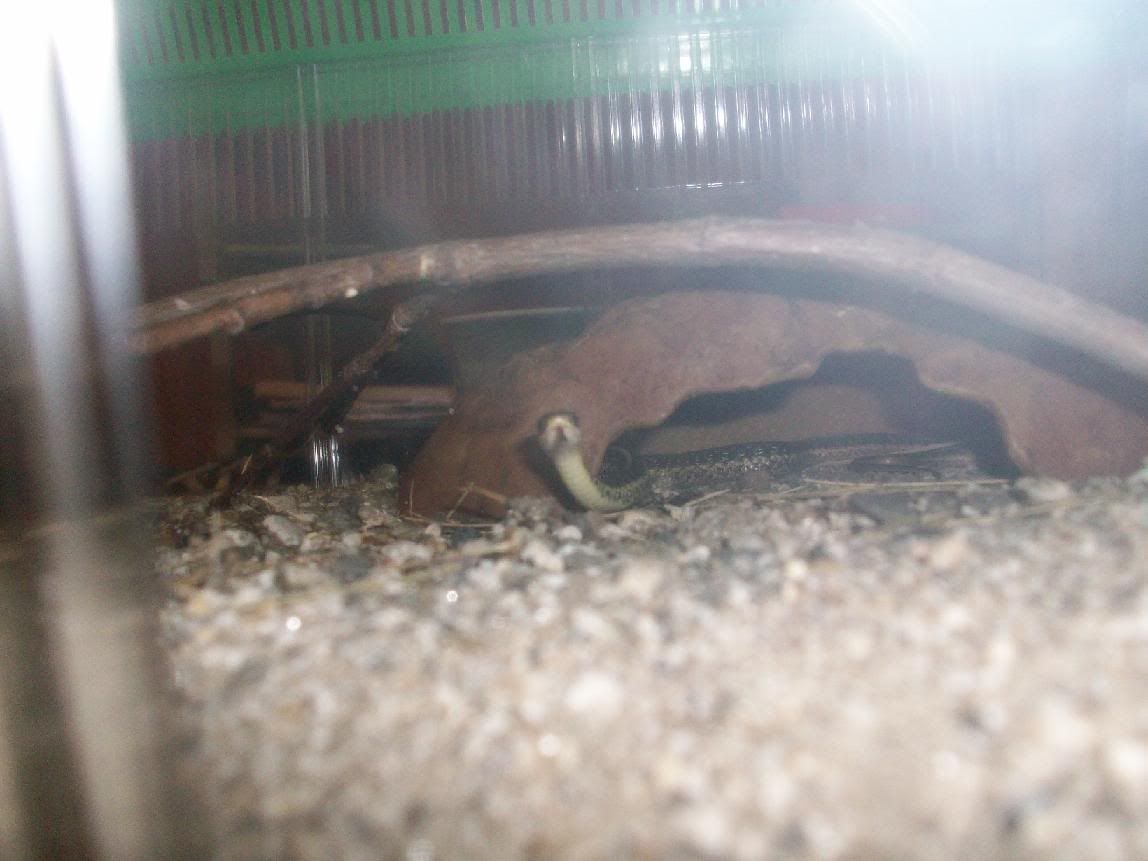
All of this talking and you still haven't actually MET Edgeworth! There he is below (this photo is roughly a year old, but he hasn't changed much except gotten a bit bigger). Click the photo to enlarge it.
Here's Wikipedia's entry on garter snakes.
http://en.wikipedia.org/wiki/Garter_snake
Thursday, January 19, 2012
What exactly IS a Turtle?
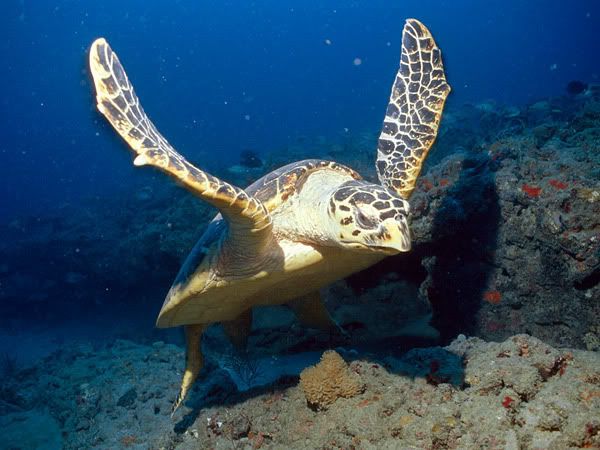
Everyone knows turtles - those interesting reptiles with shells on their backs, no teeth, and a reputation for slow speed. But you also hear about tortoises and sometimes terrapins, and looking at pictures of the three animals may have you thinking "What's the difference?". It depends partially on where you live as well as being a matter of taste. Here's a quick guide on how to name your chelonians ("chelonian" is the Latin name for the turtle family).
First, there are the ocean-living chelonians. These animals are generally quite large. They can move on land - just barely - but they are very much aquatic creatures. These animals are often called "turtles" or "sea turtles".
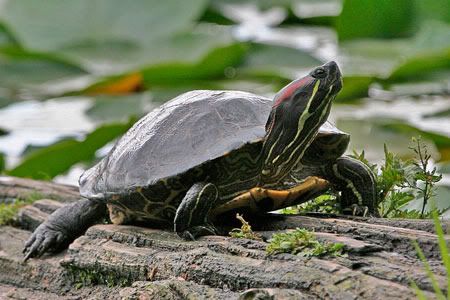
Next are the amphibious chelonians. Frequently kept as pets, these creatures live in freshwater. While generally called "turtles", people living in the UK may call them "terrapins", and some people in the United States will use the term "slider".
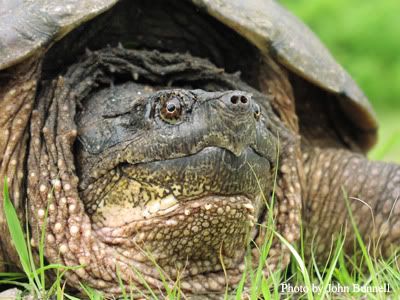
The fearsome-looking snapping turtle is always called a turtle, and doesn't fall into the same group as the other freshwater turtles.
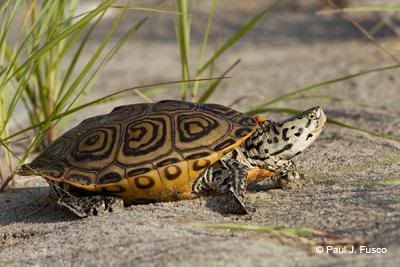
This species is called the diamondback terrapin. This is the only turtle regularly called a terrapin by people outside the UK.
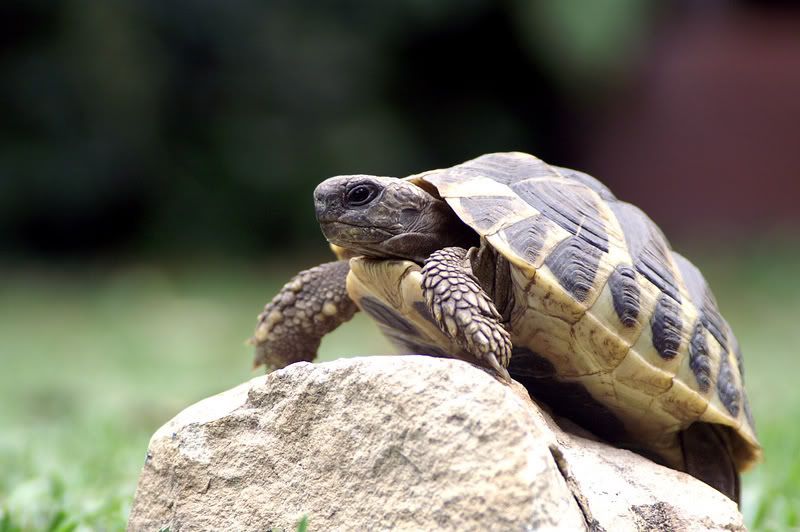
Finally, the family of land-living chelonians is referred to as "tortoises" or "box turtles". The UK generally prefers "tortoise", while most of the USA prefers "box turtle".
In short, if you want to tell the animals apart without just calling them all turtles, use "tortoise" if it has legs and "turtle" if it has flippers or webbed feet.
Here's my personal preferences on this important issue:
Ocean - Turtle
Freshwater - Turtle (exceptions: the red-eared slider and the diamondback terrapin)
Land - Tortoise
First, there are the ocean-living chelonians. These animals are generally quite large. They can move on land - just barely - but they are very much aquatic creatures. These animals are often called "turtles" or "sea turtles".
Next are the amphibious chelonians. Frequently kept as pets, these creatures live in freshwater. While generally called "turtles", people living in the UK may call them "terrapins", and some people in the United States will use the term "slider".
The fearsome-looking snapping turtle is always called a turtle, and doesn't fall into the same group as the other freshwater turtles.
This species is called the diamondback terrapin. This is the only turtle regularly called a terrapin by people outside the UK.
Finally, the family of land-living chelonians is referred to as "tortoises" or "box turtles". The UK generally prefers "tortoise", while most of the USA prefers "box turtle".
In short, if you want to tell the animals apart without just calling them all turtles, use "tortoise" if it has legs and "turtle" if it has flippers or webbed feet.
Here's my personal preferences on this important issue:
Ocean - Turtle
Freshwater - Turtle (exceptions: the red-eared slider and the diamondback terrapin)
Land - Tortoise
Tuesday, January 17, 2012
The Story of a Butterfly - Part Two
About a week after the shadowbox was added to our home's decor, my mom came home from work with a special guest. She had found another monarch butterfly in the parking lot at her place of employment. Thinking of me, she picked it up and stuck it in a little container, and then took it home. I accepted the gift warmly and inspected my latest acquisition. This butterfly was female. She was somehow in even worse condition than the male I had found two weeks before. One of her wings had a patch on it that was bubbly and wavy, like paper that has gotten wet and then dried out. Additionally, my mom had gotten the container from a coworker who smoked, so the butterfly had also been choking down nicotine for the last twenty minutes. I moved her into the same container I had used for the previous butterfly, and like the last "tenant", she spent most of her time clinging to grass and trying to gain strength.
As with the first one, I would take the female monarch out every day to hold in my hand, occasionally feeding it from dandelions. And unlike Mony, Mony The Second was starting to improve. She ignored her damaged wing and began making little fluttery jumps. With my door and window closed, I would take her out of the container each day and watch her attempt to fly. The first day she took off resulted in a clumsy, brief flight not unlike the Wright brothers' maiden voyage. Descending from my hand, she flapped and struggled her way about 3 feet in a downward arc before collapsing on my floor. I scooped her up and returned her to her container.
The next day she fared a bit better, traveling a little farther before landing on my bed. A few days later she took off from my hand, flew a complete circle around me, and came to rest in a perfect landing on my curtains. I applauded her progress. Returning her to her house with a fresh dandelion, I told her that tomorrow could be the big day.
It was a sunny early October morning. I had kept Mony the Second for about a week, and if she was strong enough, today would be her last day with me. My mom and I went outside, I with Mony the Second and she with a camera. My mom took several shots of me holding Mony the Second as she felt the crisp, clean outdoor air for the first time in a week. Mony the Second tested her wings. Open... close. Open... close. She fluttered a little but remained clinging to me. I held my hand up, allowing for a good takeoff point. All of a sudden her wings began to flap, and she leapt from my hand into the sky.
She started strong but began to sink, losing altitude quickly. For one terrible moment I thought she would crash, but Mony the Second regained her composure and began to climb again. She flew in a circle, then moved briefly over our house before changing course and moving off in a different direction. I watched the shrinking orange blur make its way along before she moved behind some trees. For a moment I saw her above the trees, and then she was gone.
"She's gone. She made it." I said. My mom stood next to me, having watched with a sense of wonder just a strong as my own.
And then we hugged each other, and I cried a little. I had done it. I had nursed a sick animal back to health. I wondered if Mony the Second realized that.
Animals may not feel human emotions, especially insects. But I can at least pretend that they do.
As with the first one, I would take the female monarch out every day to hold in my hand, occasionally feeding it from dandelions. And unlike Mony, Mony The Second was starting to improve. She ignored her damaged wing and began making little fluttery jumps. With my door and window closed, I would take her out of the container each day and watch her attempt to fly. The first day she took off resulted in a clumsy, brief flight not unlike the Wright brothers' maiden voyage. Descending from my hand, she flapped and struggled her way about 3 feet in a downward arc before collapsing on my floor. I scooped her up and returned her to her container.
The next day she fared a bit better, traveling a little farther before landing on my bed. A few days later she took off from my hand, flew a complete circle around me, and came to rest in a perfect landing on my curtains. I applauded her progress. Returning her to her house with a fresh dandelion, I told her that tomorrow could be the big day.
It was a sunny early October morning. I had kept Mony the Second for about a week, and if she was strong enough, today would be her last day with me. My mom and I went outside, I with Mony the Second and she with a camera. My mom took several shots of me holding Mony the Second as she felt the crisp, clean outdoor air for the first time in a week. Mony the Second tested her wings. Open... close. Open... close. She fluttered a little but remained clinging to me. I held my hand up, allowing for a good takeoff point. All of a sudden her wings began to flap, and she leapt from my hand into the sky.
She started strong but began to sink, losing altitude quickly. For one terrible moment I thought she would crash, but Mony the Second regained her composure and began to climb again. She flew in a circle, then moved briefly over our house before changing course and moving off in a different direction. I watched the shrinking orange blur make its way along before she moved behind some trees. For a moment I saw her above the trees, and then she was gone.
"She's gone. She made it." I said. My mom stood next to me, having watched with a sense of wonder just a strong as my own.
And then we hugged each other, and I cried a little. I had done it. I had nursed a sick animal back to health. I wondered if Mony the Second realized that.
Animals may not feel human emotions, especially insects. But I can at least pretend that they do.
Monday, January 16, 2012
The Story of a Butterfly - Part One
It was not a dark and stormy night. Rather, it was an overcast afternoon, September 2007. I was heading home after an afternoon at the library when I felt a wet plop on my head. Suspecting the worst, I paused my MP3 player and held out a hand. Sure enough, my palm was soon splattered by a drop of rain. Just my luck, I grumbled to myself. I picked up my walking speed a bit and resumed my music.
I had only traveled a few dozen more feet when something brightly colored caught my eye. Off to my right, in a patch of tall grass at the side of the road, something orange and black in color was nestled in the reeds. I moved in for a closer look and found it was a monarch butterfly. I'd seen these delicate creatures in the area before – large, handsome animals that flew gracefully and elegantly. I could tell that something was up with this one, though, as it did not flee or even move in my presence. Taking advantage of the situation, I gently scooped up the insect and began carrying it home. It moved a little – it was definitely alive – but remained quite still in my hands. The rain began to fall harder, and I sped up again, practically running now, with my newfound catch in my cupped hands, my fingers over it, shielding it from the rain. I stopped for a moment and messed with my MP3 player again. Once I had some suitably epic-sounding music pumping through my headphones, I resumed running. I’ve always had a flair for the dramatic.
Once home, I placed the butterfly in a small plastic container and added a little grass for it to perch on. There was no way I would allow this butterfly to be added to the often chaotic "main jar" all my other insect pets lived in. No, this sickly butterfly would be quarantined, and released once it felt better. It rained all the rest of that day, but the next day was clear. I ventured outdoors once more, located a dandelion, and took it inside to the butterfly. I opened its container and took it in my hand, then I presented it with the dandelion in my other hand. Slowly, the monarch’s feeding tube uncurled and delicately poked into the head of the plant. Feeding a butterfly was one of my more invigorating experiences that year. When it was done, I gently placed the monarch back in its home, with the dandelion in case it wished for more nectar later.
The next day, I did a little research on monarch butterflies after wondering if the genders could be told apart. I wanted to know what sex my own captive was. A look at my old animal encyclopedias returned an answer: Male butterflies have a black spot on each wing, towards the middle, which contains a chemical used in mating season. Later, I took a look at my own monarch, and sure enough, when it opened its wings I saw the spots. My butterfly was male.
Naming has never been a strong suit of mine, and I called my butterfly simply "Mony" (pronounced moan-ey). For several days I looked Mony over, and every day he acted the same. His condition didn’t appear to be improving or worsening one way or the other.
One morning, before going on another daily excursion to the library, I took out Mony and just looked at him. He looked back, clinging to my finger and slowly opening and closing his wings, making no attempt to fly or flee. Suddenly he raised a foreleg and... waved. I found this little movement quite funny. There was no way an insect could understand human conditions like “waving” and the like - it must have just lost its balance a little. So I laughed it off, and returned Mony to his container.
But that evening, I returned from the library to find him lying on his side in his little plastic house. He was dead. Had Mony been trying to say goodbye? Obviously not, but I didn’t mind imagining that it was so.
The next week, I purchased a shadowbox at the local dollar store, and my mother helped me mount my deceased butterfly to it with pins. Once we were finished, the shadowbox went up on the wall and is still there today – a memory of my former pet, a pet I couldn’t save.
But this story is far from over.
Saturday, January 14, 2012
This Week In Biology
Here's a quick look at some of the latest news in biology and animal studies.
Gonatocerus ovicenatus, a tiny fairyfly related to wasps, has been seen for the first time in 100 years.
http://www.physorg.com/news/2012-01-wasp-rediscovered-years.html
100 baby seals washed up on the coast of the Netherlands. Researchers claim it's because of overfishing and pollution weakening the animals enough for waves to sweep them away.
http://www.physorg.com/news/2012-01-baby-dutch-coast.html
A study has found that some species of fish grow used to certain temperatures, and condition their young to be used to these temperatures as well. Babies raised at the same temperature as their parents grew faster.
http://www.physorg.com/news/2012-01-fish-offspring-temperature-parents.html
A new species of monkey was discovered in 2010, but not photographed alive until this week. The Myanmar snub-nosed monkey lives in forested mountains near China, which is part of why it had gone undiscovered for so long.
http://www.physorg.com/news/2012-01-images-newly-primate.html
Scientists trying to stop the spread of malaria and other mosquito-borne diseases are trying a radically different approach - instead of trying to wipe out mosquitoes (which is well nigh impossible and could disrupt food chains), why not try and make mosquitoes unable to transmit malaria? Scientists are now beginning the previously-unknown task of studying the immune system of the mosquito.
http://www.physorg.com/news/2012-01-anti-viral-immune-pathway-mosquito.html
And finally, a new species of snake (a viper, specifically) was found in Tanzania two years ago and has officially been described and named this week. Researcher Tim Davenport was part of the three-man team that discovered the snake, which grows to 2 feet long. Davenport's 5-year-old daughter Matilda was present as well, and she "became fascinated by it and used to love spending time watching it and helping us look after it", he says. "We called it Matilda's Viper at that stage... and the name stuck." That's right, the species is officially named Matilda's Viper. It is believed to have a poisonous bite, but Matilda's Viper has a surprisingly calm and laid-back disposition. Davenport said he "handled one on a number of occasions". I assume Matilda didn't get to hold it, though!
http://www.foxnews.com/scitech/2012/01/11/new-venomous-snake-species-discovered-in-tanzania/
Gonatocerus ovicenatus, a tiny fairyfly related to wasps, has been seen for the first time in 100 years.
http://www.physorg.com/news/2012-01-wasp-rediscovered-years.html
100 baby seals washed up on the coast of the Netherlands. Researchers claim it's because of overfishing and pollution weakening the animals enough for waves to sweep them away.
http://www.physorg.com/news/2012-01-baby-dutch-coast.html
A study has found that some species of fish grow used to certain temperatures, and condition their young to be used to these temperatures as well. Babies raised at the same temperature as their parents grew faster.
http://www.physorg.com/news/2012-01-fish-offspring-temperature-parents.html
A new species of monkey was discovered in 2010, but not photographed alive until this week. The Myanmar snub-nosed monkey lives in forested mountains near China, which is part of why it had gone undiscovered for so long.
http://www.physorg.com/news/2012-01-images-newly-primate.html
Scientists trying to stop the spread of malaria and other mosquito-borne diseases are trying a radically different approach - instead of trying to wipe out mosquitoes (which is well nigh impossible and could disrupt food chains), why not try and make mosquitoes unable to transmit malaria? Scientists are now beginning the previously-unknown task of studying the immune system of the mosquito.
http://www.physorg.com/news/2012-01-anti-viral-immune-pathway-mosquito.html
And finally, a new species of snake (a viper, specifically) was found in Tanzania two years ago and has officially been described and named this week. Researcher Tim Davenport was part of the three-man team that discovered the snake, which grows to 2 feet long. Davenport's 5-year-old daughter Matilda was present as well, and she "became fascinated by it and used to love spending time watching it and helping us look after it", he says. "We called it Matilda's Viper at that stage... and the name stuck." That's right, the species is officially named Matilda's Viper. It is believed to have a poisonous bite, but Matilda's Viper has a surprisingly calm and laid-back disposition. Davenport said he "handled one on a number of occasions". I assume Matilda didn't get to hold it, though!
http://www.foxnews.com/scitech/2012/01/11/new-venomous-snake-species-discovered-in-tanzania/
Thursday, January 12, 2012
Amphibians, Big and Small
Let's talk a bit about amphibians.
The word "amphibian" means "double life". This refers to the life cycle of frogs and other amphibians - they start out as aquatic animals (tadpoles) before growing up into animals that can live on land (frogs). Aside from frogs and toads, salamanders and newts are also amphibians, as well as a few rarer and lesser-known creatures.
Scientists are always discovering new species of animals, and frogs are one of the more common creatures to pop up on "Newly Discovered" lists. A new frog has been found in Papua New Guinea, and it's one of the smallest invertebrates ever found. The frog averages 7 millimeters long (that works out to 0.27 of an inch). For comparison, a dime is 18 millimeters across.
In direct contrast to this tiny frog, the largest amphibian has been known for quite some time - the Chinese giant salamander can reach six feet in length. Sadly, this very interesting - if not conventionally attractive - creature is critically endangered and almost never gets to reach that size anymore. Thanks to pollution, habitat loss, and the fact that some Chinese consider it a delicacy, the giant salamander generally only grows to 4 feet on average. It has a relative, the Japanese giant salamander, that is almost exactly the same in appearance and habits, although it is a little smaller.
In prehistoric times, amphibians got even larger than six feet. The all-time largest amphibian known to man is Prionosuchus, a prehistoric creature that looked more like a crocodile than today's amphibians, and could reach a length of thirty feet. It went extinct a very long time ago - even before the dinosaurs first appeared.
World's smallest frog:
http://www.bbc.co.uk/news/science-environment-16491477
Photo slideshow dedicated to the giant salamander:
http://news.bbc.co.uk/2/hi/science/nature/8500486.stm
The biggest amphibian of all time, the extinct Prionosuchus:
http://en.wikipedia.org/wiki/Prionosuchus
The word "amphibian" means "double life". This refers to the life cycle of frogs and other amphibians - they start out as aquatic animals (tadpoles) before growing up into animals that can live on land (frogs). Aside from frogs and toads, salamanders and newts are also amphibians, as well as a few rarer and lesser-known creatures.
Scientists are always discovering new species of animals, and frogs are one of the more common creatures to pop up on "Newly Discovered" lists. A new frog has been found in Papua New Guinea, and it's one of the smallest invertebrates ever found. The frog averages 7 millimeters long (that works out to 0.27 of an inch). For comparison, a dime is 18 millimeters across.
In direct contrast to this tiny frog, the largest amphibian has been known for quite some time - the Chinese giant salamander can reach six feet in length. Sadly, this very interesting - if not conventionally attractive - creature is critically endangered and almost never gets to reach that size anymore. Thanks to pollution, habitat loss, and the fact that some Chinese consider it a delicacy, the giant salamander generally only grows to 4 feet on average. It has a relative, the Japanese giant salamander, that is almost exactly the same in appearance and habits, although it is a little smaller.
In prehistoric times, amphibians got even larger than six feet. The all-time largest amphibian known to man is Prionosuchus, a prehistoric creature that looked more like a crocodile than today's amphibians, and could reach a length of thirty feet. It went extinct a very long time ago - even before the dinosaurs first appeared.
World's smallest frog:
http://www.bbc.co.uk/news/science-environment-16491477
Photo slideshow dedicated to the giant salamander:
http://news.bbc.co.uk/2/hi/science/nature/8500486.stm
The biggest amphibian of all time, the extinct Prionosuchus:
http://en.wikipedia.org/wiki/Prionosuchus
Wednesday, January 11, 2012
Insect Photography
Here are some photos I've taken of insects over the last couple years. Click on each image for a larger view.
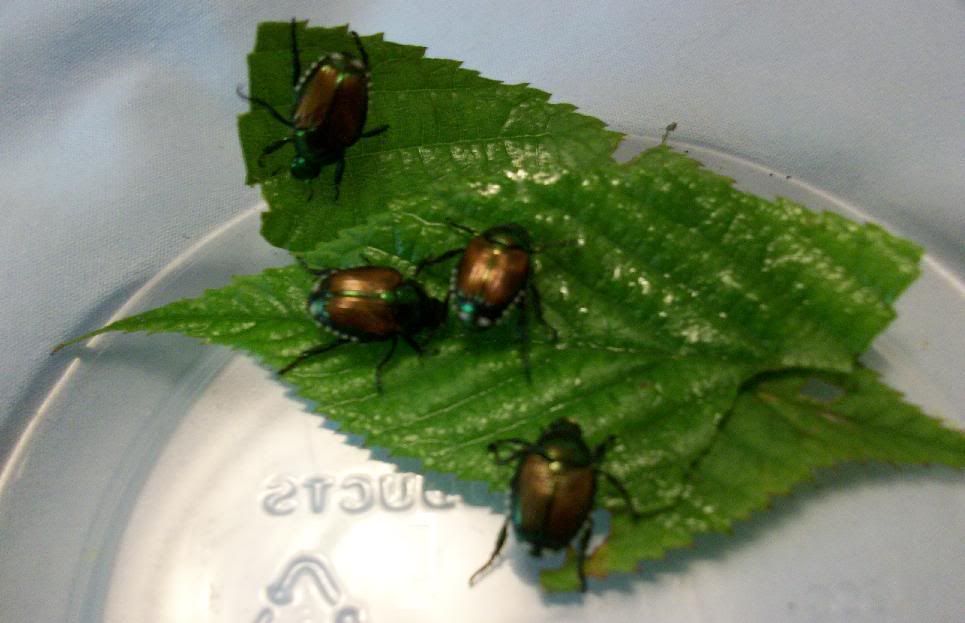
Japanese beetles are an invasive pest species that strip plants in great numbers. They've been a bit less common around here in recent years, but there's still plenty to go around in the second half of summer.
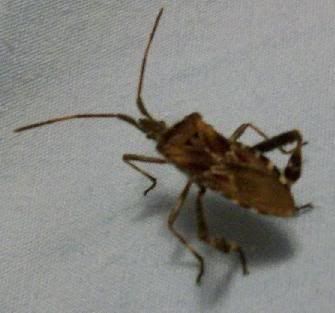
This critter is a type of stinkbug. Stinkbugs are beetles best known for their noxious odor, hence the name. I've encountered stinkbugs several times but never been attacked by their smelly spray, luckily enough. They like to show up in fall.
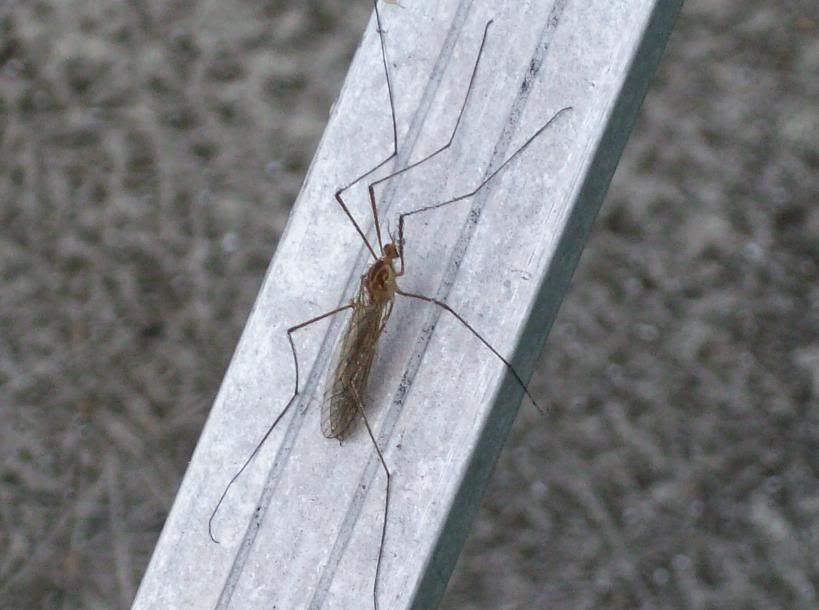
Crane flies are strange animals - how did evolution decide that this was a good idea? I'm still not sure, myself, but something about these long-legged, ungainly, poor flyers with no working mouthparts is a success because I see plenty of them every August.
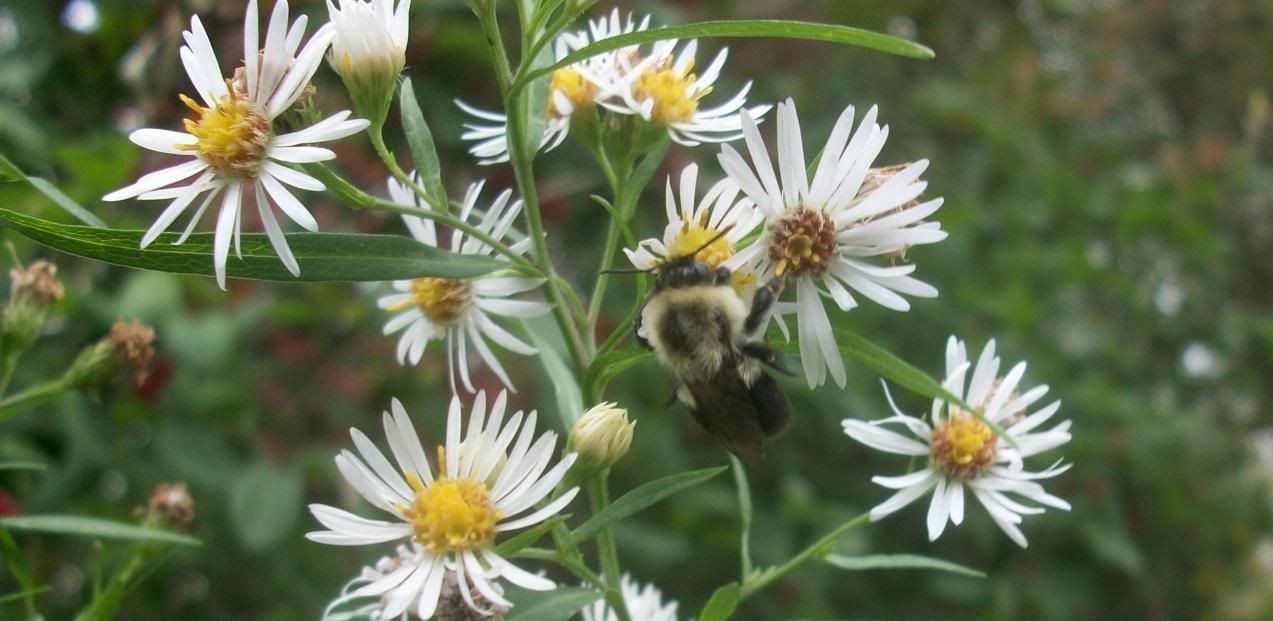
The other photos here are all a year or three old, but this one was shot just last fall. It is, of course, a bumblebee. Bumblebees are simultaneously cute and intimidating - they can sting multiple times since their stingers don't have barbs, but if you leave them alone they're generally happy campers and won't try to fight you.
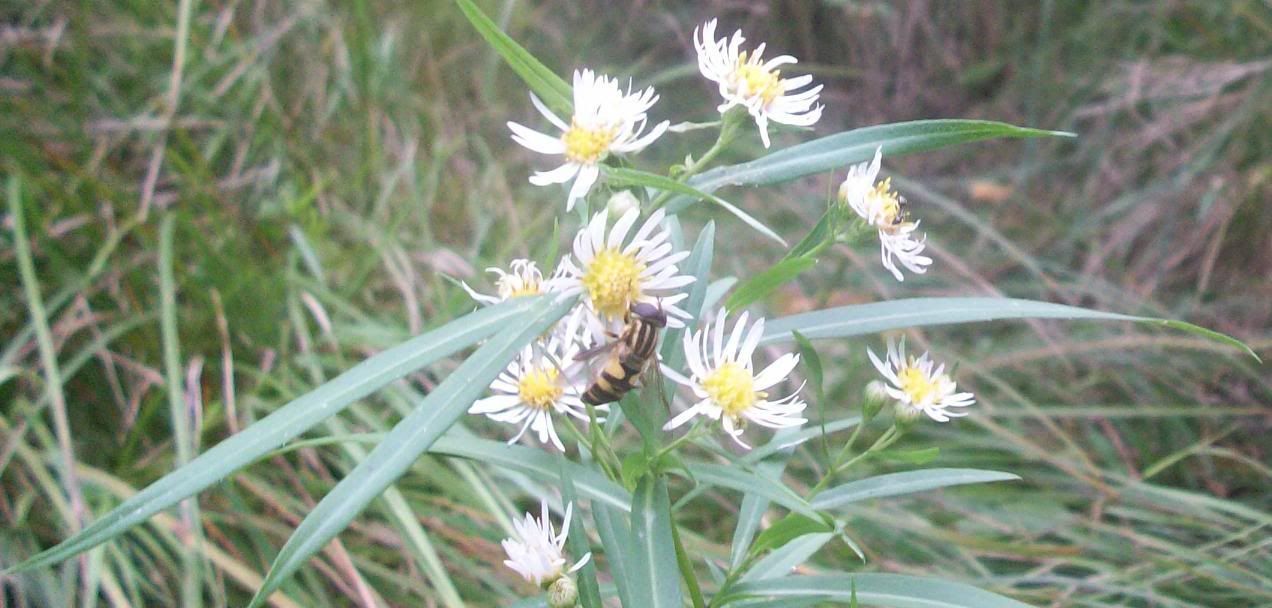
Just a few moments after photographing the above bee, this wasp flew in to visit the same plant. It was a lot more active than the bee, so I was lucky to get a shot this nice.
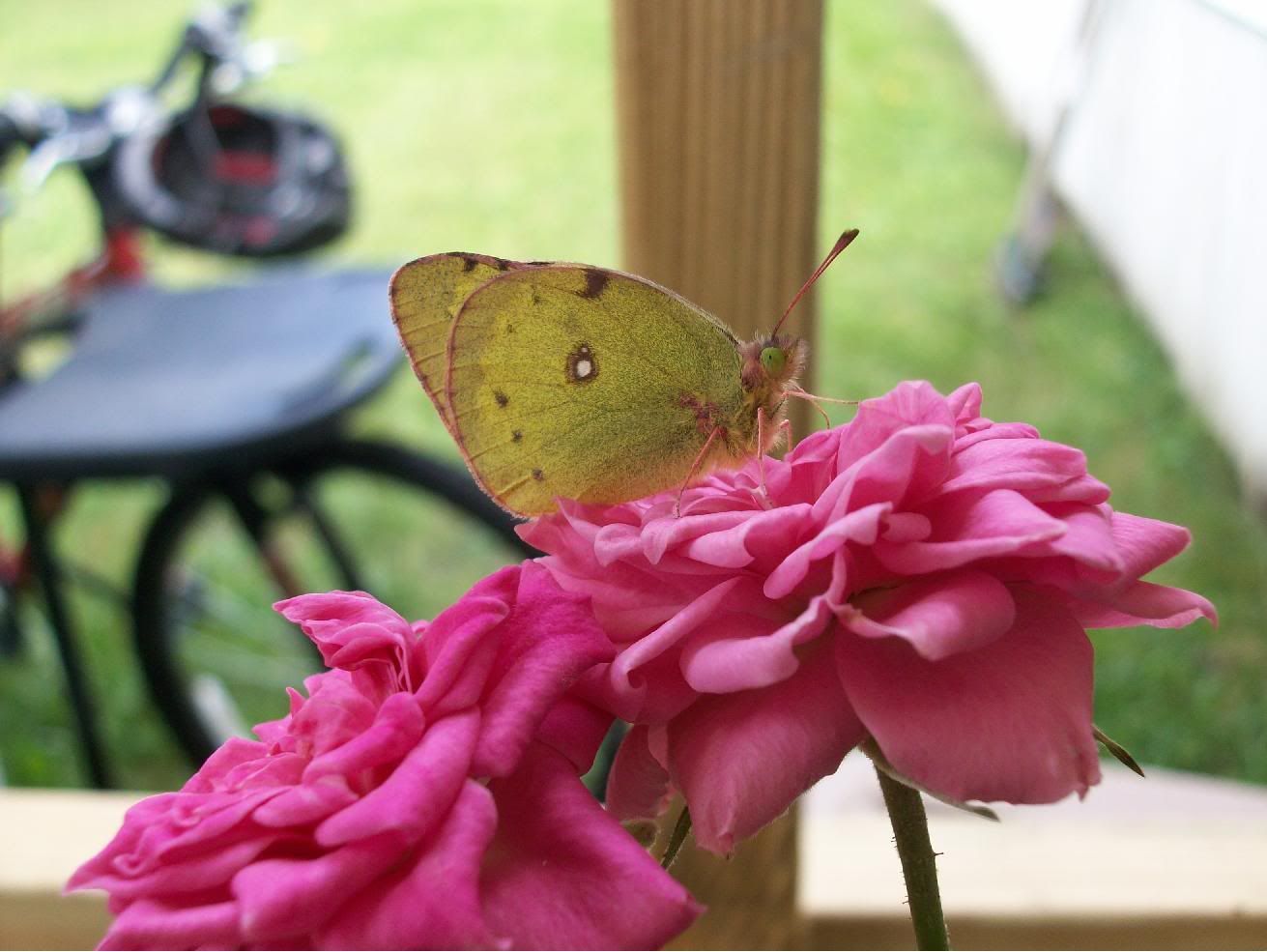
Out of all my insect photos, this is the one I'm proudest of. This butterfly wasn't feeling too well and so I was able to get a spectacular shot of it by picking it up and letting it sit on these flowers. Later the weather warmed up enough for it to fly away.
Japanese beetles are an invasive pest species that strip plants in great numbers. They've been a bit less common around here in recent years, but there's still plenty to go around in the second half of summer.
This critter is a type of stinkbug. Stinkbugs are beetles best known for their noxious odor, hence the name. I've encountered stinkbugs several times but never been attacked by their smelly spray, luckily enough. They like to show up in fall.
Crane flies are strange animals - how did evolution decide that this was a good idea? I'm still not sure, myself, but something about these long-legged, ungainly, poor flyers with no working mouthparts is a success because I see plenty of them every August.
The other photos here are all a year or three old, but this one was shot just last fall. It is, of course, a bumblebee. Bumblebees are simultaneously cute and intimidating - they can sting multiple times since their stingers don't have barbs, but if you leave them alone they're generally happy campers and won't try to fight you.
Just a few moments after photographing the above bee, this wasp flew in to visit the same plant. It was a lot more active than the bee, so I was lucky to get a shot this nice.
Out of all my insect photos, this is the one I'm proudest of. This butterfly wasn't feeling too well and so I was able to get a spectacular shot of it by picking it up and letting it sit on these flowers. Later the weather warmed up enough for it to fly away.
Tuesday, January 10, 2012
Why Do Some People Fear Snakes and Spiders?
A "phobia" is an irrational fear of something. Someone with a phobia will not only be afraid to confront their fear, but they may get extremely worked up just reading about it, seeing it on TV, or talking about it with someone else. Common phobias include achluophobia (fear of the dark), acrophobia (fear of heights), glossophobia (fear of speaking in public), necrophobia (fear of death or dead things), and coulrophobia (fear of clowns). The two phobias I'm talking about today, however, are arachnophobia and ophidiophobia - the fear of spiders and the fear of snakes, respectively.
While I do have some "fears", of a sort, such as a problem with meeting strangers and, when I was younger, a severe dislike and fear of earthworms, I do not have any true phobias. I count both spiders and snakes as two of my favorite animals - but the opinion isn't shared in my home. I seem to be the only member of my family who can stand snakes - which makes it all the more remarkable that I have one as a pet.
I'll be posting about my pet snake later. First, I've wanted to figure this question out for quite some time - why are so many people afraid of snakes and spiders? Why those two animals? Why not crocodiles or bears or sharks? Mosquitoes kill more people every year than any other animal by spreading disease, so why are they treated with annoyance rather than fear? There must be something in the human psyche that makes spiders and snakes stand out as especially fearsome, even when there are so many harmless members of either animal (especially spiders).
A study reported on in National Geographic back in 2001 claims that recognizing snakes and spiders as dangerous is ingrained in our minds from evolution. Primitive man, who lived in the wild far from today's comforts of enclosed, insulated homes, often had to be on alert for predators. Snakes, which tend to rely on stealth and can hide easily due to their shape, may have been a high priority target to memorize the appearance of. Spiders are harder to explain, thanks to the species that can truly threaten humans being fairly uncommon.
While I understand that some people can have phobias, I grow worried when I hear of prejudice against snakes and spiders just because they are snakes and spiders. A snake may be a far cry from a cat or dog, but it's very possible to own one and bond with it in some fashion. Millions of people are afraid of snakes and spiders, but there are also many folks out there who keep these feared animals as beloved pets. There are cases of people's pet snakes being killed by people who feared them. I've linked to one of the most memorable cases of anti-snake violence below. Even if you don't care for certain animals, you should never hurt or kill someone's pet just because it's a species you don't happen to like.
A list of the many, many phobias that have been coined over the years:
http://phobialist.com/
National Geographic's article on snake and spider fear:
http://news.nationalgeographic.com/news/2001/10/1004_snakefears.html
The sad story of Popcorn the ten-foot albino python:
http://local.cincinnati.com/share/news/story.aspx?sid=117013&cid=100004
While I do have some "fears", of a sort, such as a problem with meeting strangers and, when I was younger, a severe dislike and fear of earthworms, I do not have any true phobias. I count both spiders and snakes as two of my favorite animals - but the opinion isn't shared in my home. I seem to be the only member of my family who can stand snakes - which makes it all the more remarkable that I have one as a pet.
I'll be posting about my pet snake later. First, I've wanted to figure this question out for quite some time - why are so many people afraid of snakes and spiders? Why those two animals? Why not crocodiles or bears or sharks? Mosquitoes kill more people every year than any other animal by spreading disease, so why are they treated with annoyance rather than fear? There must be something in the human psyche that makes spiders and snakes stand out as especially fearsome, even when there are so many harmless members of either animal (especially spiders).
A study reported on in National Geographic back in 2001 claims that recognizing snakes and spiders as dangerous is ingrained in our minds from evolution. Primitive man, who lived in the wild far from today's comforts of enclosed, insulated homes, often had to be on alert for predators. Snakes, which tend to rely on stealth and can hide easily due to their shape, may have been a high priority target to memorize the appearance of. Spiders are harder to explain, thanks to the species that can truly threaten humans being fairly uncommon.
While I understand that some people can have phobias, I grow worried when I hear of prejudice against snakes and spiders just because they are snakes and spiders. A snake may be a far cry from a cat or dog, but it's very possible to own one and bond with it in some fashion. Millions of people are afraid of snakes and spiders, but there are also many folks out there who keep these feared animals as beloved pets. There are cases of people's pet snakes being killed by people who feared them. I've linked to one of the most memorable cases of anti-snake violence below. Even if you don't care for certain animals, you should never hurt or kill someone's pet just because it's a species you don't happen to like.
A list of the many, many phobias that have been coined over the years:
http://phobialist.com/
National Geographic's article on snake and spider fear:
http://news.nationalgeographic.com/news/2001/10/1004_snakefears.html
The sad story of Popcorn the ten-foot albino python:
http://local.cincinnati.com/share/news/story.aspx?sid=117013&cid=100004
Subscribe to:
Posts (Atom)